
Promotional Calendar Printing: Imprint Methods and Resale-Ready Packing
Promotional calendar printing is a bulk order of calendars carrying one organisation’s branding, produced for a brand, a gift distributor or an importer to give away or resell. Three decisions control the result: the imprint method that puts the logo on the cover, the packing that lets the units move straight onto a shelf, and the order date that lands stock in the warehouse before the season. This page covers those three from the production side, which is the part most supplier pages leave out, and it follows the same sequence the Shenzhen Longyin Printing Packing Co., Ltd. team works through before a promotional run is quoted.
Key Takeaways
- One artwork set per order: every copy in a promotional calendar run is printed identically, and individual logos or recipient names are not part of the process.
- The imprint method decides how the logo behaves: foil and embossing carry brand weight but need a die, spot UV disappears on uncoated stock, and process colour cannot hit a Pantone reference exactly.
- Format sets the production window: saddle stitched 5-7 days, wire-o 8-10, desk 10-12 and 365-day 18-20, all counted from confirmed files.
- Resale-ready packing is a specification, not a default: unit wrap, shelf-ready inner carton, unbranded outer carton, fixed unit count and destination labels.
- The calendar printing lead time is worked backwards from the delivery date: pre-press, sample, production and freight each add days, and runs above 5,000 copies add 5-7 more.
Table of Contents
- What counts as a promotional calendar order?
- Which imprint methods put a logo on a calendar?
- Which format and binding suits a promotion?
- What does resale-ready packing include?
- Which artwork details decide whether the logo prints correctly?
- When should the order be placed for Q4 distribution?
- What payment and after-sales terms apply?
- FAQ: Logo, Packing and Lead Time Questions
Send your specs and get a custom quote.
What counts as a promotional calendar order?
A promotional calendar is a bulk order printed with one organisation’s branding for distribution to customers, staff or retail buyers. It is one artwork set, one print run and one packing specification, ordered in the hundreds or thousands, and it is judged on how the logo reads at arm’s length rather than on the artwork inside.
That last point separates it from a retail calendar. A retail calendar is published to be sold through book trade channels, so it carries a publisher imprint, a retail price area and a barcode on the back. A promotional calendar carries none of those by default: the cover belongs to the organisation giving it away, and the back page is usually where a contact address, a branch list or a short brand message goes.
The buyers fall into three groups, and each one specifies the job differently. Brands order for their own giveaway and care most about how the logo sits on the cover. Gift distributors resell the finished calendars to their own clients and care about packing, carton counts and how the units look on a shelf. Importers stock a seasonal programme and care about the order window and the freight route, because a late shipment is worth nothing once the season has passed. Each of those is a wholesale calendar printing job before it is a design job, because the units have to arrive saleable and on time. Orders like this are usually run as advertising calendar printing, where one design carries the brand across every copy.
What all three have in common is that the calendar has to survive a year on a wall or a desk while still looking like the brand that paid for it. That is a production question rather than a design question, and it is answered by the imprint method, the stock and the packing rather than by the artwork.
Which imprint methods put a logo on a calendar?
Six calendar imprint methods cover most logo work: a Pantone spot colour on an offset press, four-colour process, foil stamping, debossing or embossing, screen printing and spot UV. Each one changes what the logo can be, what the artwork has to contain, and whether a die or an extra plate is needed before the run can start.
| Method | What it does to the logo | Main limitation |
|---|---|---|
| Pantone spot colour, offset | Flat, exact brand colour on a coated cover | One plate and one ink per colour; a photographic logo still needs process |
| Four-colour process | Reproduces photographs and gradients behind the mark | Brand colours shift; a Pantone reference cannot be matched exactly |
| Foil stamping | Metallic or pigmented foil pressed in with a heated die | A die per foil colour; no gradients, and fine reversed text fills in |
| Debossing or embossing | A recessed or raised mark with no ink | A die is needed, and the effect fades on thin or soft stock |
| Screen printing | Thick, opaque ink that holds on dark or coloured board | Coarse detail; halftones and small type break up |
| Spot UV | A gloss pattern sitting on a matte laminated cover | Invisible on uncoated stock; needs sharp contrast and tight registration |
The choice is made against three facts rather than against a preference: the stock the cover is printed on, the size the logo will actually print at, and the finish already on the board. Foil reads strongest on a dark uncoated cover, but the die is a fixed set-up, so it belongs on a run long enough to carry it. Spot UV only exists in contrast, which means a matte lamination has to be added first, and that lamination is a separate pass with its own lead time.
Combining methods is normal, and it is where schedules are won or lost. A Pantone mark inside a spot UV panel is two passes beyond the four-colour printing; a foil logo on a debossed panel is three. The count of passes, not the count of colours, is what lengthens the schedule, which is why calendar imprint methods are agreed with the artwork rather than after the proof is approved. It is also where a custom calendar printing with logo order either holds its mark for a year or loses it in the first month.

Which format and binding suits a promotion?
Format follows where the calendar will live. A wall calendar suits a broad giveaway because it stays visible for a year; a desk calendar suits client gifts that sit in an office; a 365-day block suits a premium gift with a long desk life. The binding then fixes the production window the order date is built around.
| Format | Where it works | Binding | Production |
|---|---|---|---|
| Wall calendar | Broad giveaway that has to stay visible | Punched sheets on a wire-o or spiral, hanger bar at the head | 8-10 days |
| Slim wall calendar | Large-volume handout with a short grid | Folded sheet, saddle stitched through the spine | 5-7 days |
| Desk calendar | Client gift that has to sit on a desk | Tent base or wire-o stand | 10-12 days |
| 365-day block | Premium gift with one page per day | Glued or wired block on a stand | 18-20 days |

Two rules sit behind that table. A saddle stitched calendar is limited by extent, because the sheet has to divide into fours and the spine only holds a thin page, so it suits a short single-fold line rather than a thirteen-month grid on heavy stock. A wire-o calendar tolerates heavier pages and a larger open size, but every sheet has to be punched to the same pattern, which is why the drilling pattern is confirmed with the artwork rather than at the binding stage. A desk calendar works the other way round: the base and the stand take the space a hanger bar takes on a wall calendar, which is why desk calendar printing is quoted with the base included.
The hanger is part of the format, not an accessory. A metal hanger bar, a drilled head or a punched hole each changes the trim at the top of the sheet, the height of the packed unit and the number of cartons the run fills. Naming the hanger with the format keeps the packing figure and the freight figure consistent with the calendar that is actually being made.
What does resale-ready packing include?
Resale-ready packing means a carton can be opened at the receiving end and the units go out again without being repacked: each calendar wrapped individually, an inner carton that works as a display or shelf unit, an outer carton with no supplier branding, a fixed unit count and labels that match the destination.
- Unit protection – a poly bag or a shrink wrap with a header card, so the cover is not scuffed before it reaches the buyer.
- Inner carton – a shelf-ready or counter display carton that can go out as it arrives instead of being emptied first.
- Outer carton – unbranded, with no supplier name, order number or packing list printed on the outside.
- Fixed unit count – the same number of calendars in every carton, so stock can be counted without opening anything.
- Carton labels – destination, carton number and unit count, plus a decision on who applies a barcode if the retail channel needs one.
- Split delivery – whether the run ships to one address or several, because multiple destinations change the marking and the freight.
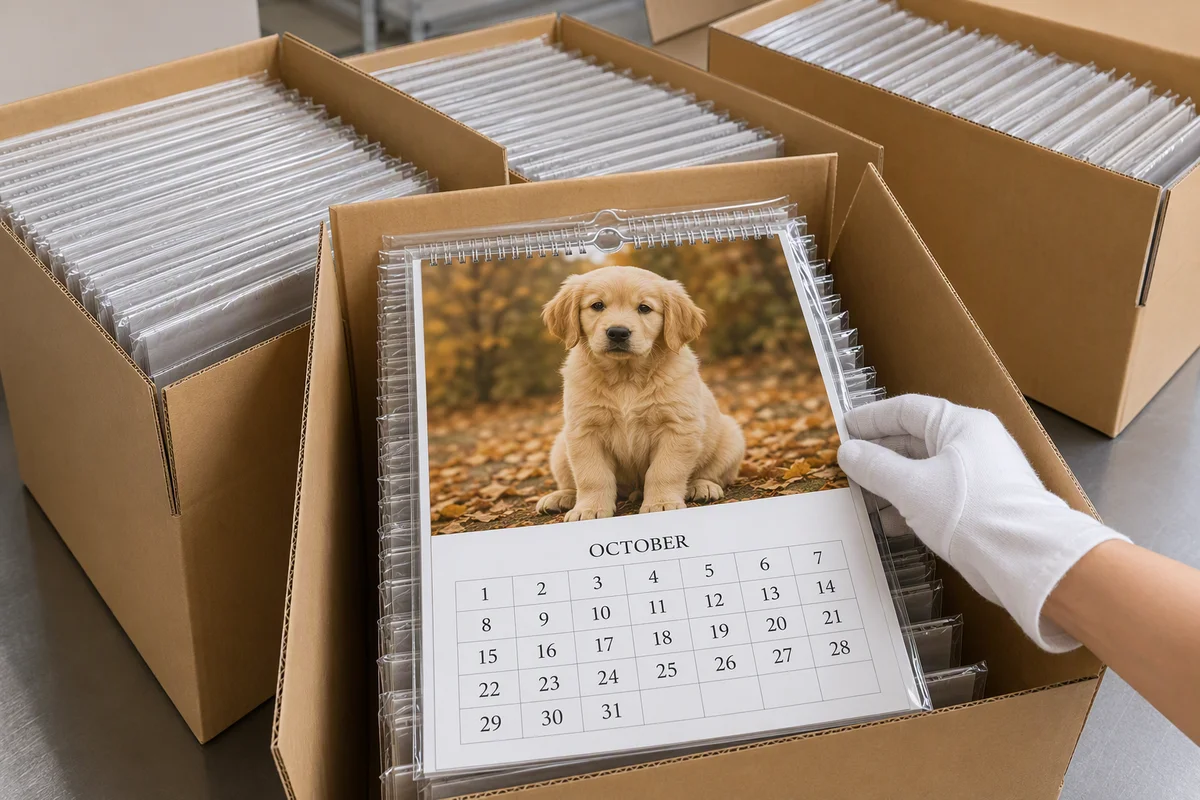
Packing is decided with the artwork rather than after printing, because the unit wrap adds thickness to every calendar. That thickness changes the carton dimensions, the count of cartons and the volume the forwarder quotes on, so a packing specification written late in the job usually ends in either under-filled cartons or a second packing pass.
For a distributor, the test is simple: open one carton and check whether the units can be handed to a retail buyer without being touched again. If they cannot, the packing specification is not finished, and wholesale calendar printing orders that skip this step tend to arrive as a bulk pallet of loose calendars rather than as saleable stock.
Every format in that packing list, from a wire-o wall calendar to a 365-day block, comes off the same calendar printing line, so the packing specification can be priced with the format instead of being added after the run is confirmed.
Which artwork details decide whether the logo prints correctly?
Five items decide whether the logo survives production: a die line that matches the trimmed format, a safe area that keeps the mark clear of the trim and the punch, the position of the hanger or the stand, a logo supplied as vector art in the right colour build, and a minimum print size for the mark.
- Die line and trim – the cut outline plus a bleed so the printed area reaches the edge after trimming; artwork that stops at the trim line shows a white sliver on the finished calendar.
- Safe area – the punched head, the wire holes and any fold each take a strip out of the panel, so the logo and any legal line stay inside the safe area rather than near the edge.
- Hanger or base – the head of a hanging calendar loses height to the hanger bar, and a desk calendar loses the base panel, so the cover layout has to be built around the hardware.
- Colour build – a Pantone reference has to be a spot swatch rather than a converted value, foil art has to be solid with no gradients, and white text inside a foil area has to be a reversed shape rather than white ink.
- Minimum size – a mark with a fine strapline breaks up when it is printed small, so either the logo is printed larger or the strapline is dropped for the calendar version.
One rule sits above all of these. A promotional calendar order carries a single artwork set: every copy in the run comes off the same plates and the same file, so the cover, the logo and the grids are identical across the whole quantity. Custom calendar printing with logo work therefore means one logo per order, not one logo per unit. A list of individual names, branch marks or personalised covers would need a separate plate or a separate pass for every version, and that is a different job from a bulk run; where a programme needs several versions, the workable route is to split it into separate runs, each with its own artwork set and its own plates.
The same applies to a printed recipient name or a code inside the calendar. It is not part of a standard promotional run, and asking for it at the proof stage is what turns a three-week schedule into a redraw. A programme that needs several versions is planned as separate bulk wall calendar printing runs, one artwork set each, rather than as one run with variation inside it.
When should the order be placed for Q4 distribution?
Work backwards from the date the calendars have to be in your warehouse. Pre-press takes 1-2 days on a print-ready file, the sample 1-2 days after the files are confirmed, production 5-20 days depending on binding, and air freight 5-7 days, so a wire-o run needs about three weeks and a 365-day block about four and a half.
| Stage | Covered by | Time |
|---|---|---|
| Pre-press | Print-ready file, no special process | 1-2 days |
| Sample | Confirmed file to finished sample | 1-2 days |
| Sample with special finishing | Foil, emboss, screen or spot UV | add 2-3 days |
| Production | Saddle stitched wall calendar | 5-7 days |
| Production | Wire-o or spiral wall calendar | 8-10 days |
| Production | Desk calendar | 10-12 days |
| Production | 365-day block | 18-20 days |
| Volume | Runs above 5,000 copies | add 5-7 days |
| Freight | Air | 5-7 days |
| Freight | Sea | within a month on nearby routes, 2-3 months to remote |
Read as a sum rather than a single number, the calendar printing lead time for a wire-o run of 3,000 units is 15 days at the fastest and 21 days at the outer end, counted from the day the files are supplied: 1-2 days pre-press, 1-2 days sample, 8-10 days production and 5-7 days air. A 365-day block ordered on the same day runs 25 to 31 days. Runs above 5,000 copies add 5-7 days to either figure.
The date that matters is the one on which the calendars have to be in the warehouse, not the date the order is placed. A Q4 programme usually has to be in stock before the gifting season opens, and a sea shipment takes up to a month on nearby routes and longer to remote ones, so the choice between air and sea is made weeks before the order is confirmed. Left until the artwork is finished, the schedule compresses at the wrong end, where a reprint is no longer possible.
The stage-by-stage view of wall calendars, including which specification items move the figure, is set out in our bulk wall calendar printing guide, and the same production rows apply here.
What payment and after-sales terms apply?
Payment runs on a 40% deposit with the balance settled before shipment. Sampling follows a stated policy: where a tooling or special-process plate fee applies and the bulk run keeps the same artwork, that fee is refunded once the order reaches 1,000 copies or more. Where the sampling fee covers no tooling or special process plate cost, it is not refundable. Transit damage and quality faults are handled as two separate cases.
Sampling itself runs in six steps: contract signed, sampling fee paid, files supplied, files confirmed, sample made, sample shipped. The sample is where the imprint method stops being a description, because foil depth, spot UV contrast and screen print opacity are all judged on a physical cover rather than on a screen. Corrections made at that point cost a re-proof; corrections made after the run has printed cost a reprint.
Terms are also where a quote shows how it was built. A figure that names the calendar imprint methods, the stock, the binding and the packing can be checked line by line against the specification, and the patterns that explain why two quotes for the same calendar sit apart are covered in our why book printing quotes differ page.
After delivery, the two cases run on different routes. Where a shipment is damaged or lost in transit, the carrier settles the value of the goods and the freight, and any reprint is agreed with the buyer. Where the finished calendars are unusable because of a quality problem, the order is reprinted or refunded. Confirming both in writing with the deposit keeps the terms settled before production rather than after the cartons land.
FAQ: Logo, Packing and Lead Time Questions
These are the six questions buyers raise most often before a promotional calendar order is confirmed, answered with the deciding rule first so a specification can be checked against them. Each answer states the limit before the option, because the limit is what decides whether a method, a format or a packing specification fits the job.
Q1: What is promotional calendar printing?
A bulk order of calendars printed with one organisation’s branding for giveaway or resale. The run uses a single artwork set, so the cover, logo and grids are identical on every copy, and the quantity is counted in hundreds or thousands.
Q2: Which imprint method is best for a logo on a calendar?
Match the method to the stock and the size of the mark. Foil and embossing carry the most brand weight on a heavy cover, a Pantone spot colour reproduces an exact brand colour, screen printing holds on dark board, and spot UV adds gloss on laminated stock.
Q3: Can each calendar in one order carry a different logo or name?
No. One artwork set is used per order and every copy is printed identically, so a run cannot carry individual logos or recipient names. Several versions mean several separate runs, each with its own plates, which is a different order.
Q4: What does resale-ready packing include?
Individual unit wrap, a shelf-ready or display inner carton, an unbranded outer carton, a fixed unit count per carton, destination labels, and a decision on whether the run ships to one address or several.
Q5: How far ahead should promotional calendars be ordered?
Count backwards from the delivery date. Pre-press takes 1-2 days, the sample 1-2 days after files are confirmed, production 5-20 days by binding, and air freight 5-7 days. Runs above 5,000 copies add 5-7 days, and sea freight can take up to a month.
Q6: What happens if the calendars arrive damaged?
Two cases are handled differently. Where the shipment is damaged or lost in transit, the carrier settles the value of the goods and the freight, and any reprint is agreed with you. Where the finished calendars are unusable because of a quality problem, the order is reprinted or refunded.
Written by the Longyin Printing team – book and calendar printing specialists for publishers, brands and distributors worldwide.
Send your specs and get a custom quote.