
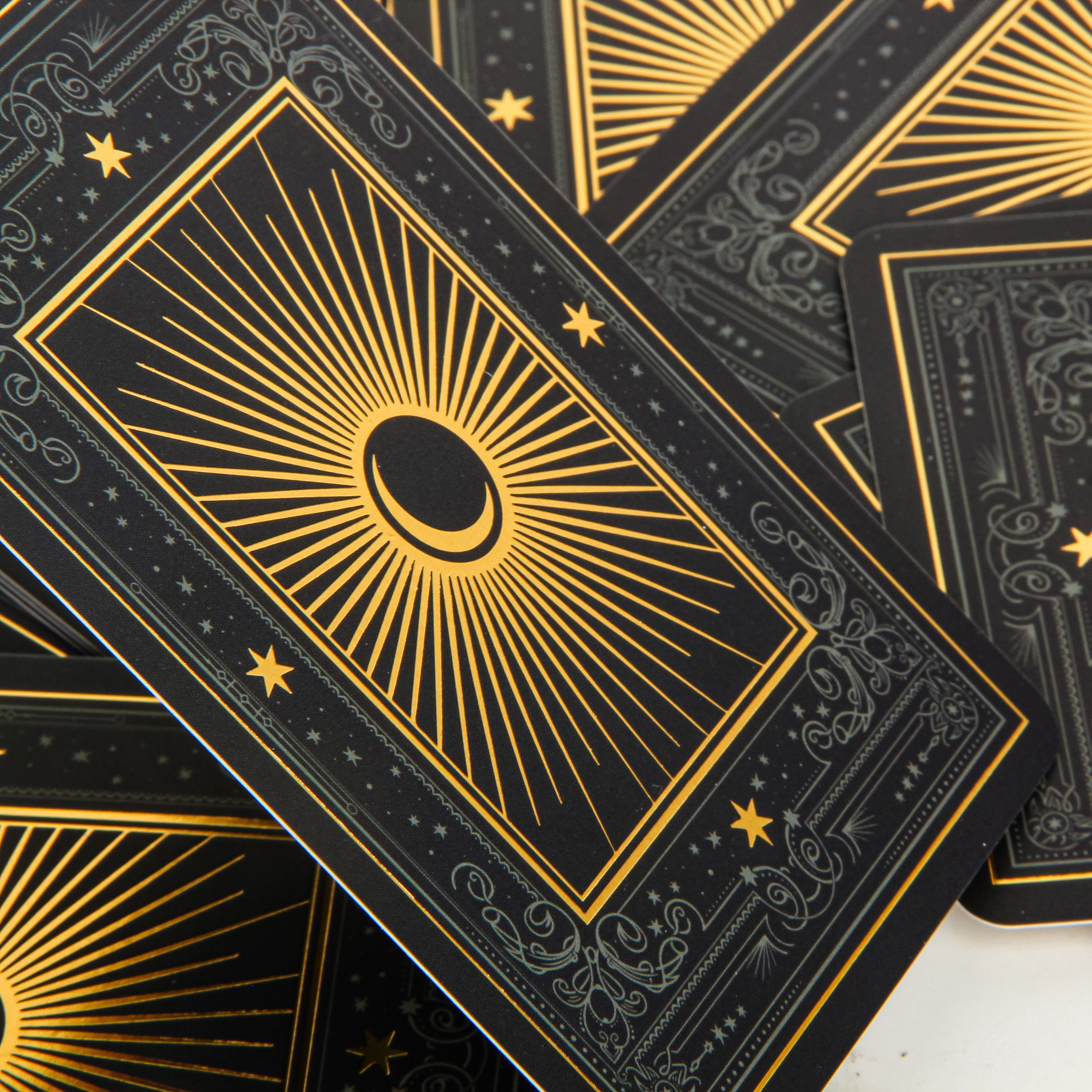
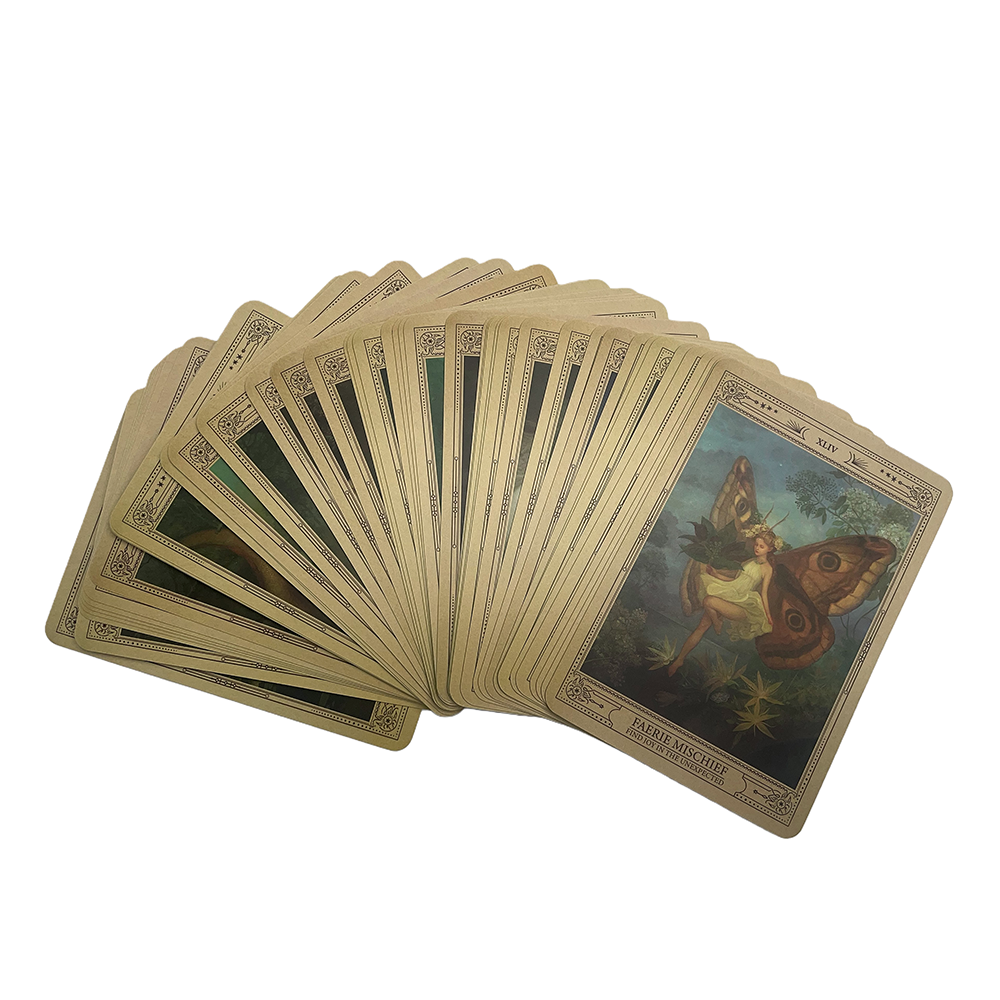
Custom Tarot Cards with Guidebook — Magnetic Flip Box, Gold Foil and Gilded Edges
A custom tarot card set is four things produced as one unit: the deck, the box it opens from, the edges that catch the light when the cards are fanned, and the guidebook that teaches the deck. We make all four under one roof, so the card back, the box lid and the book cover carry the same artwork and the same foil, and the set arrives as a finished object rather than four components from four suppliers. Everything is made to order at Imprenta Longyin to your card count, card size, stock, foil artwork and box dimensions.
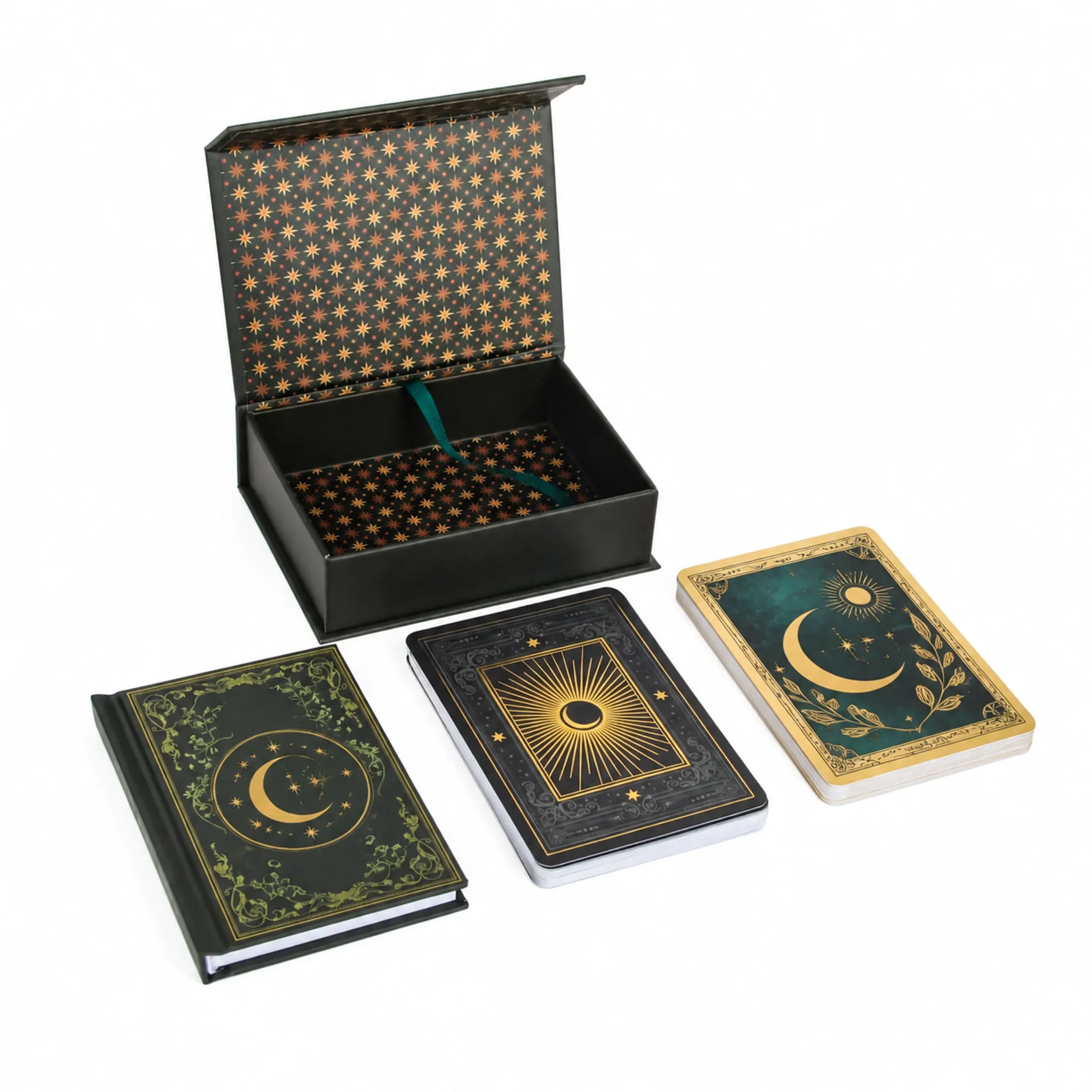
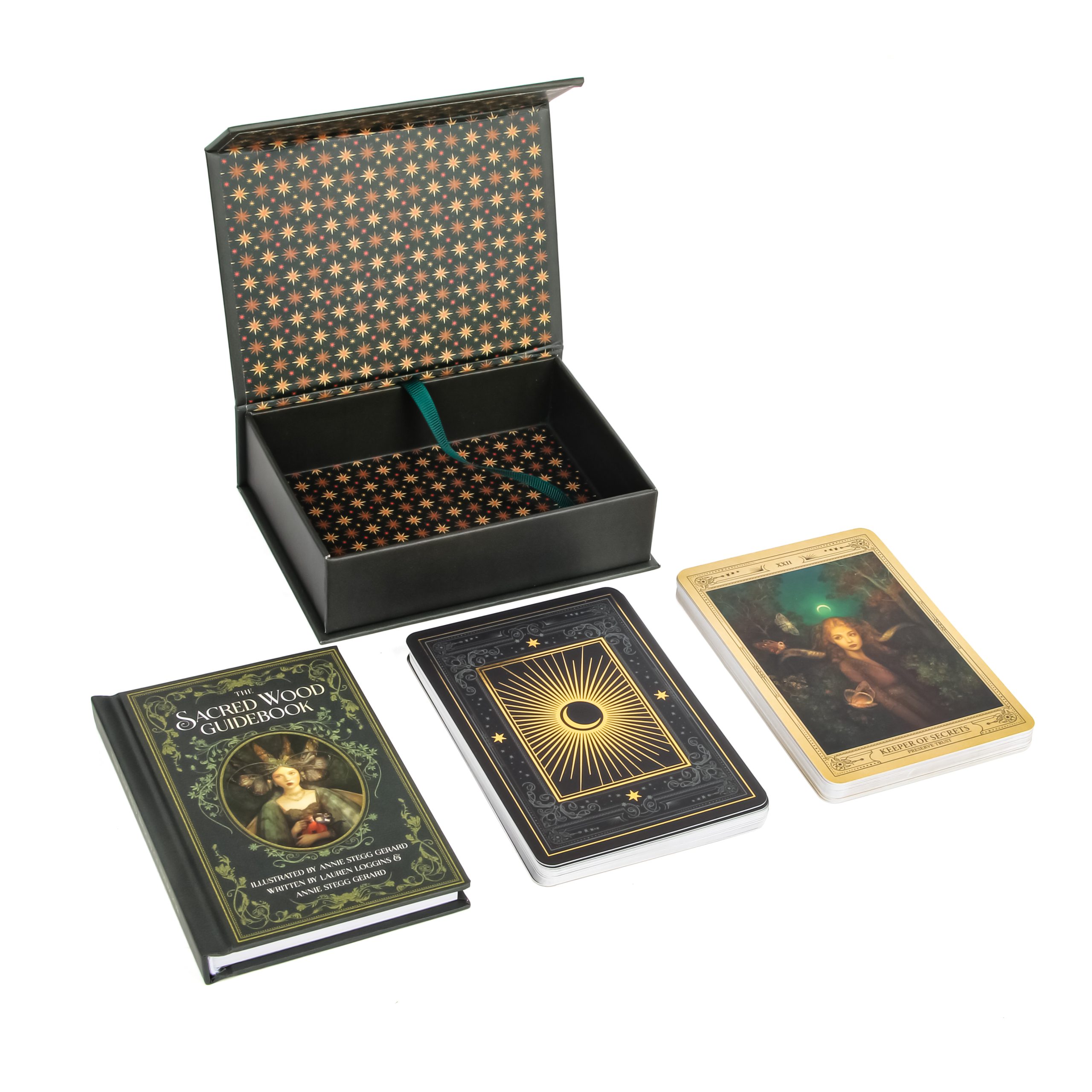
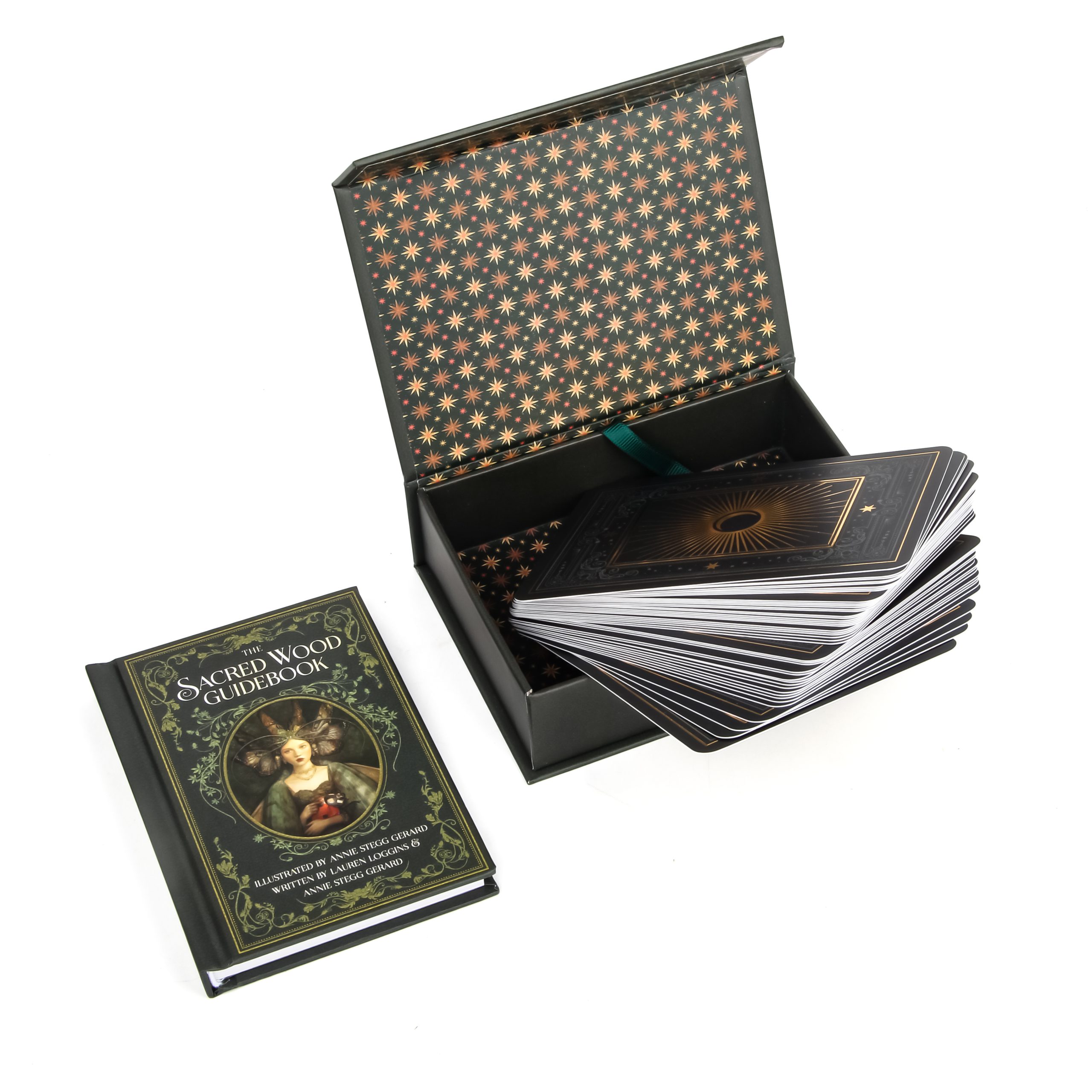
The sample set: flip box, star printed liner, ribbon lift, gilded deck and bound guidebook.
Send your specs and get a custom quote.
What Comes in a Custom Tarot Card Set
A complete set is the deck, a rigid box with a magnetic flip lid, a bound guidebook and any insert that holds the deck in place, all produced to one artwork. The deck sits in the base with a ribbon lift running underneath it, so the deck can be raised out without tipping the box over, and the lid carries the title. Nothing in the set is bought in ready-made: the box is wrapped in your printed paper, the cards are cut to your size, and the book is printed and bound with the same foil as the lid.
| Component | What we produce to your spec |
|---|---|
| Deck | 44, 56 or 78 cards cut to your size, printed both sides, corners rounded to your radius |
| Box | Rigid board box with a lid hinged along the back and two embedded magnets at the front edge |
| Interior | Base cavity sized to the deck, with a ribbon lift under the deck or a thumb notch, and a printed liner |
| Guidebook | Saddle-stitched, perfect-bound or case-bound, printed in colour or black plus one |
| Foil | One foil colour, or several, stamped on the lid, the card back and the book cover from the same die artwork |
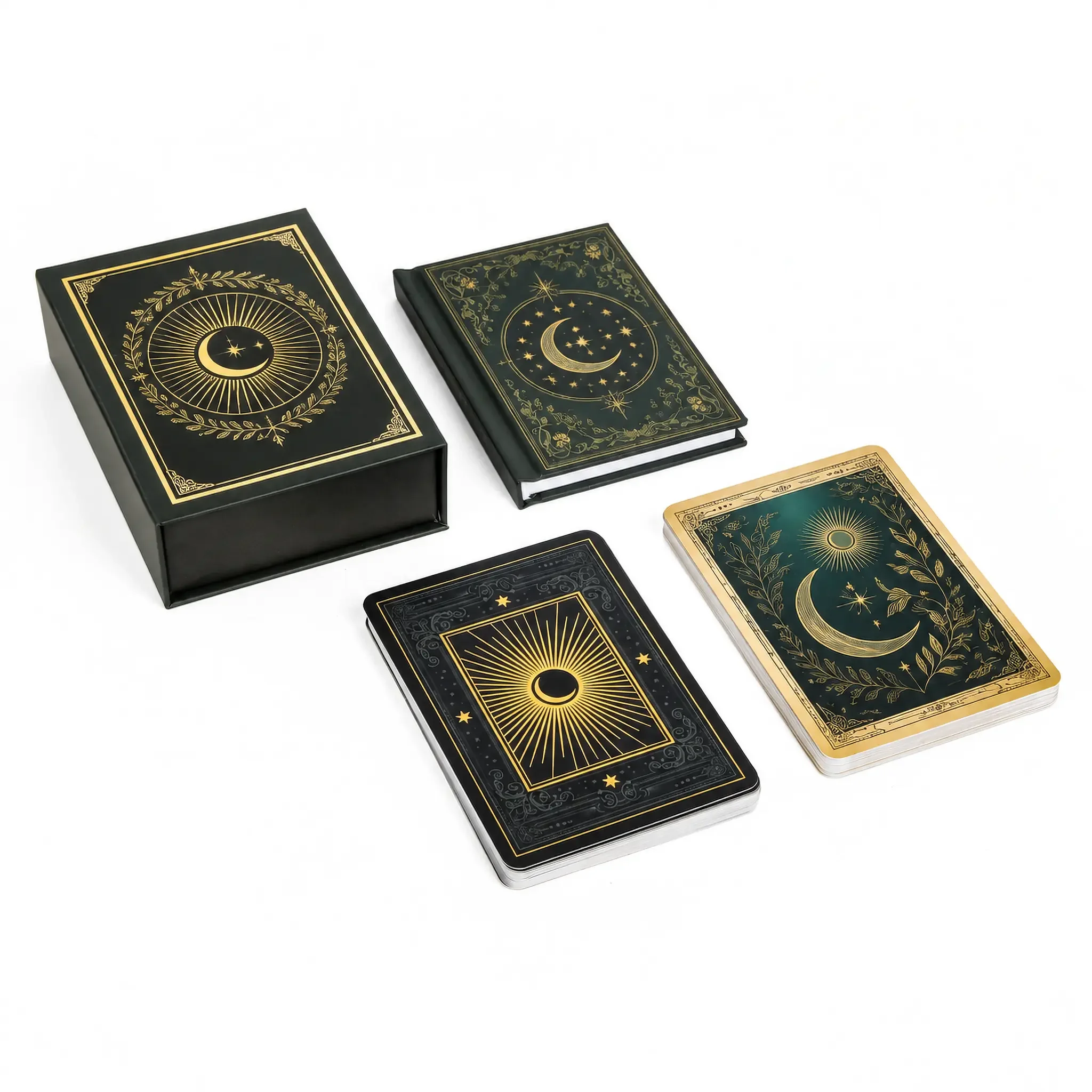
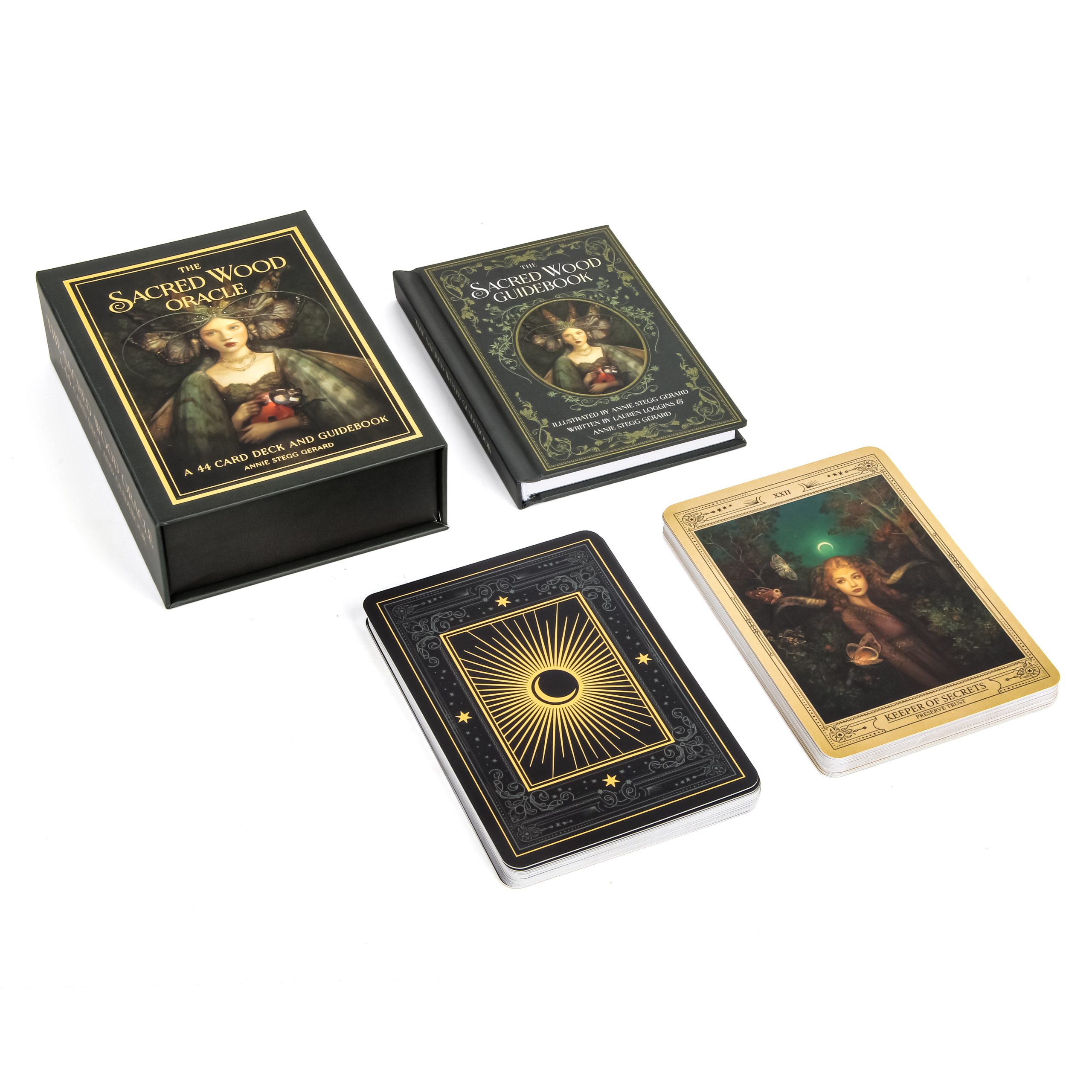
Lid, guidebook and deck carrying one black and one foil, printed and finished in the same run.
Why the Box Uses a Magnetic Flip Lid
A magnetic closure tarot box keeps the lid attached to the base and shuts with a click instead of a paper tab that wears out. The lid is hinged along the back on a wrap that is part of the printed paper, and two round magnets are set into the front wall of the lid and the base so they meet flush when the box closes. That matters for a deck that is opened and closed for years: a tuck flap softens and stops gripping within months, while a magnet pair holds the same force on the thousandth opening as on the first. The box is built on rigid greyboard rather than folded paperboard, so the walls stay flat and the lid does not bow over a thick deck and a book.
Magnet position, the gap between the lid and the base, and the depth of the cavity are set together, because a deck plus a book needs a cavity deeper than a deck alone. The same rigid format is what we use for the custom rigid gift boxes we make for other gift sets, with the interior built around the contents.
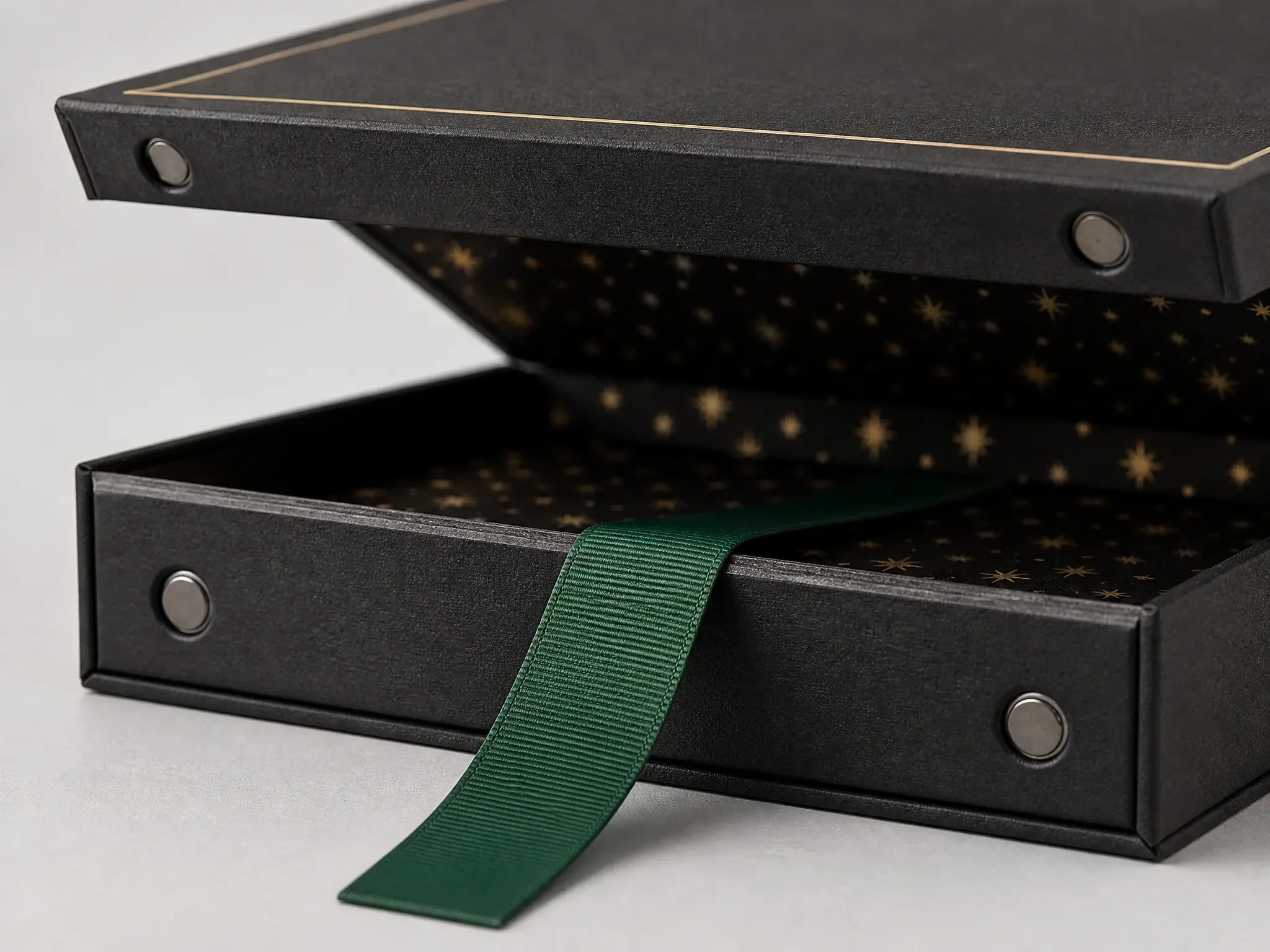
Two magnets in the lid wall meet two in the base wall, so the lid shuts flush and stays closed.
Gold Foil on the Box, the Card Back and the Book
Hot foil stamping presses a metallic layer into the sheet under heat and pressure, so the foil sits in a shallow impression rather than on top of the print. That is why a foil border reads as part of the material and catches light at an angle, while a gold ink print looks flat beside it. On a tarot set the foil usually runs on three surfaces that are seen together: the ornamental border on the lid, the emblem on the card back, and the frame on the guidebook cover. All three are stamped from artwork prepared for foil, which means solid areas, minimum line weights and no fine hairlines that would break up.
A small box is harder to stamp than a large one. The lid is a separate wrapped board, so the foil has to be registered to the wrap before the board is turned in, and the pressure is set against the paper rather than the board underneath. Gold foil tarot cards also carry foil on the card stock itself, where the stamped area sits under the varnish and has to survive shuffling: foil on a card face is specified in a band that does not cross the corner radius, because foil at a cut corner lifts.
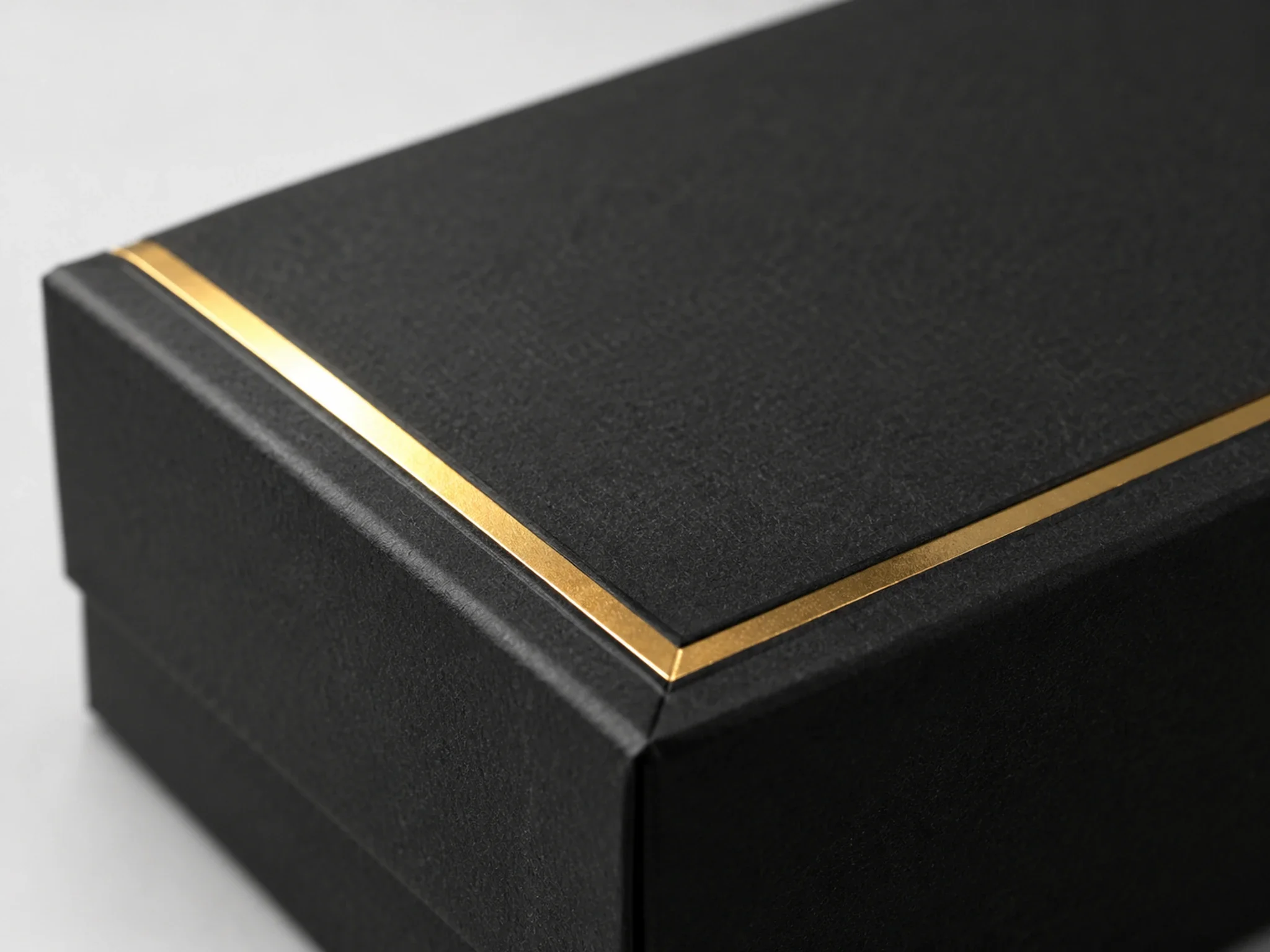
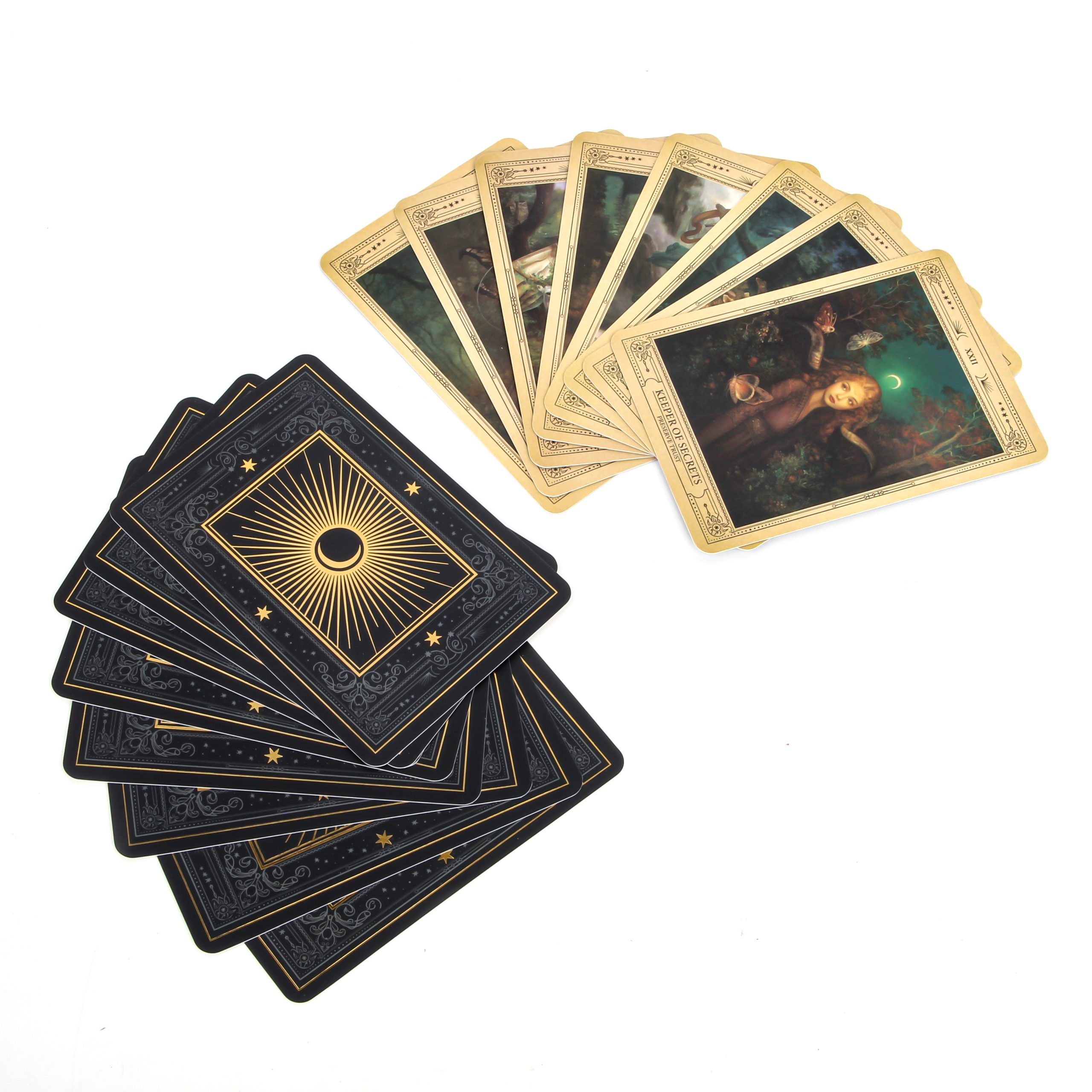
Foiled border on a wrapped rigid lid, stamped into the sheet rather than printed on top of it.
Gold Gilded Edges: What Changes After the Cards Are Cut
Gilding is applied to the deck after the cards are cut and collated, so what you see is a sealed block of edges rather than gold printed on each card. The deck is clamped square, the edge is prepared, and a metallic layer is applied and burnished so the three open sides carry one continuous gold face. That is why a gilded deck looks like a solid block from the side and a single card looks plain-edged once it is separated from the pack.
Two things decide whether gilding holds: the squareness of the cut and the dryness of the stock. A deck cut slightly out of square shows a stepped edge under the gold, so the cut is checked before gilding rather than after, and coated art card is given time to stabilise so the edge does not crack when the cards flex. Gilding is available in gold, and in other metallic tones on request. It is applied to the deck as a whole, so a mixed deck with different edge colours is not produced as one set.
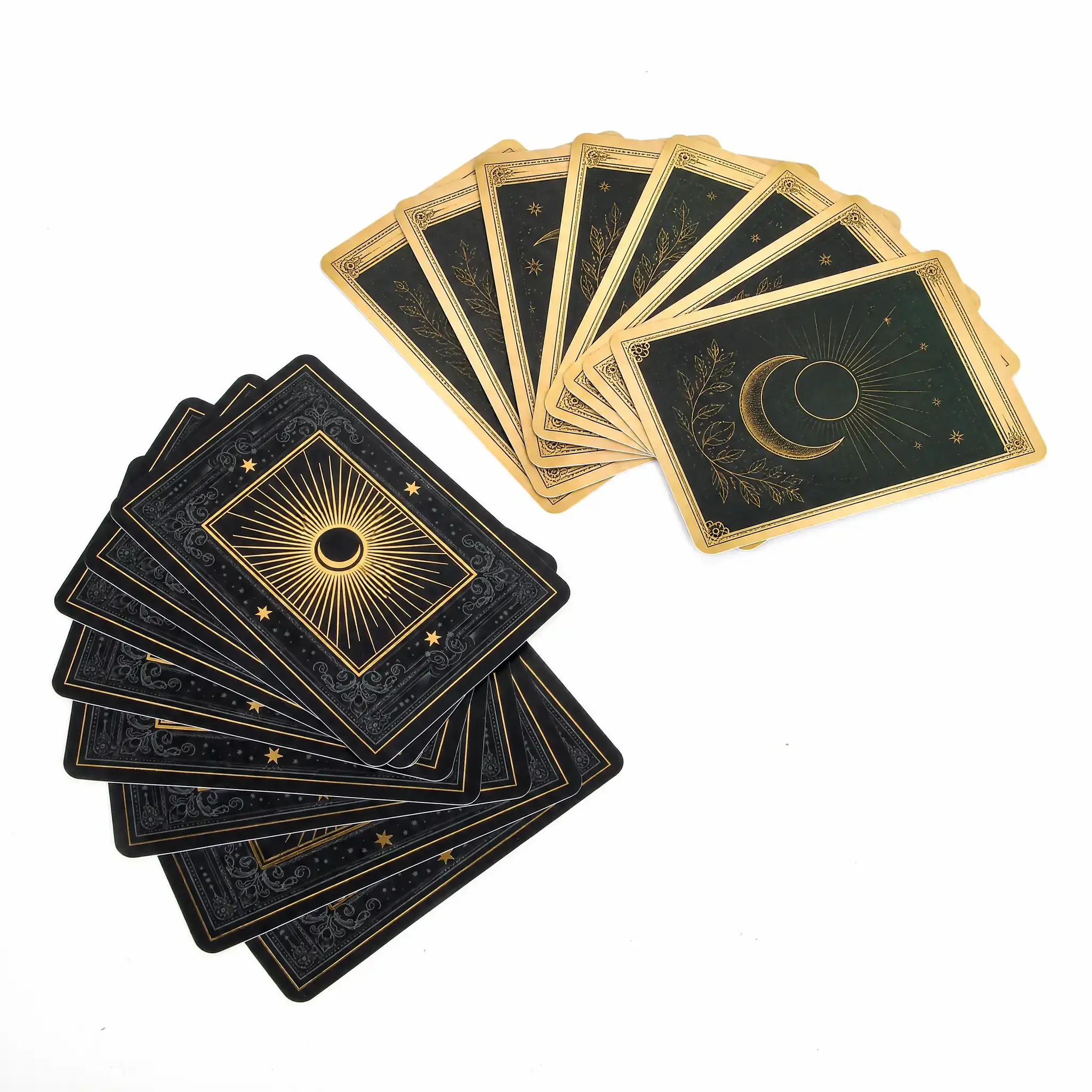
Gilding on the cut block: the three open sides read as one gold face across the fan.
Card Stock: Coated Art Card and the Alternatives
Tarot cards are normally printed on 300 to 400 gsm coated art card, and the choice of stock decides how the deck shuffles, how it fans and how the foil behaves. Coated art card takes offset print and foil cleanly, gives a bright image on the face and a crisp foil on the back, and is the stock most decks use. Heavier stock feels more substantial in the hand but is harder to riffle; lighter stock shuffles easily but can feel thin at 78 cards. Every stock below is printed and cut to the same deck size, so the choice is made on feel rather than on format.
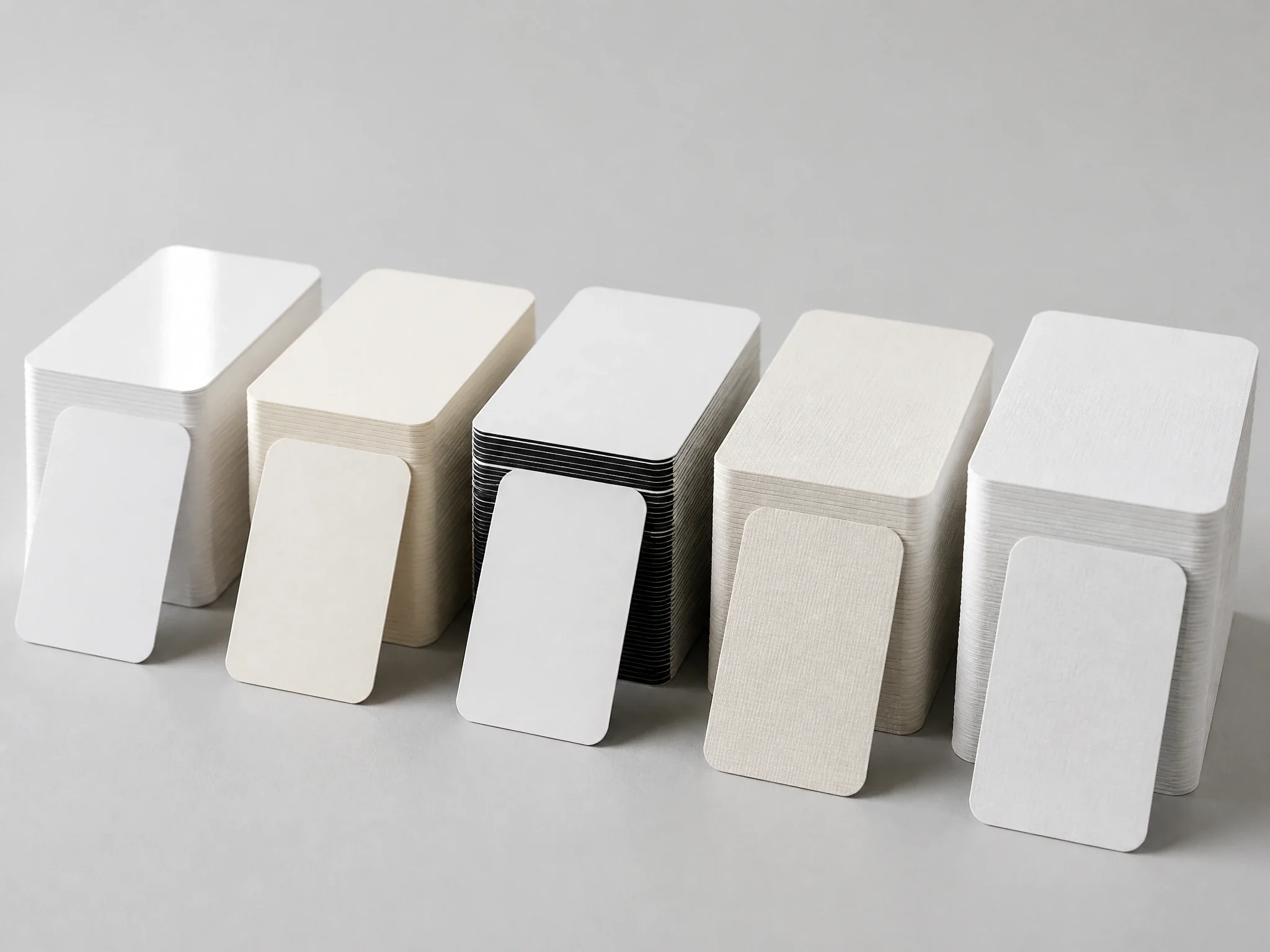
Left to right: 350 gsm gloss coated, cream uncoated, black core, linen textured, 400 gsm heavy card.
| Stock | How it feels and what it suits |
|---|---|
| 350 gsm coated art card | The default for tarot. Bright face print, clean foil on the back, firm but still shuffleable |
| Uncoated cream card | A matte, soft pencil-on-paper look, with softer colour and no gloss |
| Black core card | An opaque black centre so a card held to the light does not reveal the face behind it |
| Linen textured card | A fine woven surface that slides instead of sticking, and hides fingerprints on a dark back |
| 400 gsm coated art card | A heavier hand for a keepsake deck. Firmer snap, less riffle, suited to collectible editions |
Box Surface Finishes and What They Do to Print
The finish on the box decides how the lid reads in a photograph, how it feels in the hand and how long the print survives being carried. A matte lamination flattens reflection so a deep black stays deep black and the foil beside it reads brighter; a soft-touch film adds a velvety grip that shows handling marks sooner; a gloss film makes colour stronger but shows fingerprints on dark covers; spot UV prints a gloss pattern onto a matte surface so the pattern appears only at an angle. Textured and linen-effect films hide scuffs on a box that travels.
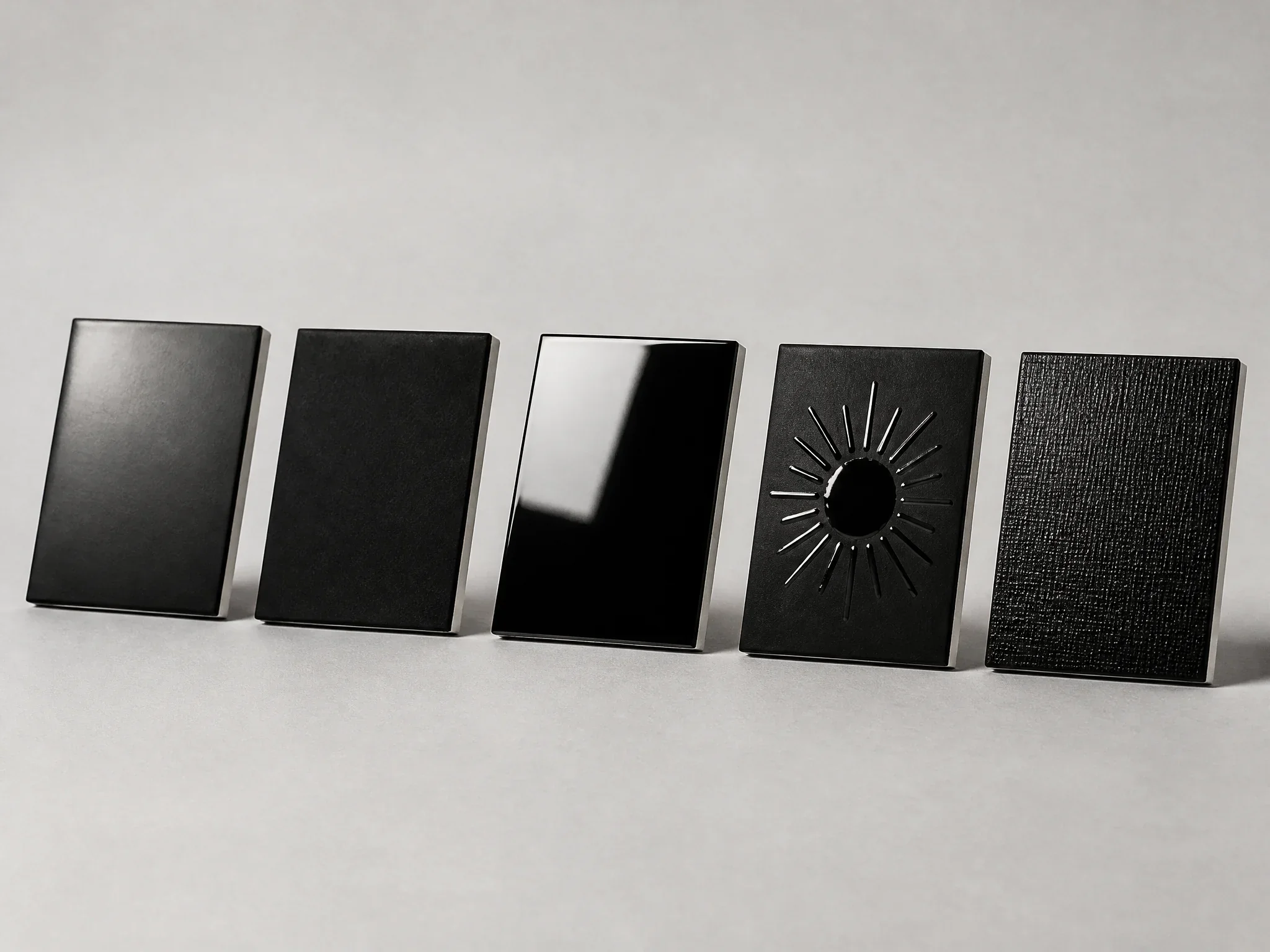
Left to right: matte lamination, soft-touch film, gloss film, spot UV on matte, textured film.
| Finish | Effect on a dark lid |
|---|---|
| Matte lamination | No glare, foil stands out, deep solids stay even. The usual choice beside foil |
| Soft-touch film | Velvet grip, expensive in the hand, but marks from fingers show and are hard to wipe off |
| Gloss lamination | Strongest colour and contrast, at the cost of glare and visible fingerprints on black |
| Spot UV over matte | A gloss pattern on a matte sheet, visible only as the box turns. Suits a motif or a border |
| Textured or linen film | A woven surface that scuffs less and feels like cloth, with softer detail in fine print |
The Guidebook: How It Is Bound
The binding follows the page count: a booklet of 32 to 48 pages is saddle-stitched, a 96 to 160 page guide is perfect-bound, and a thick guide meant to last is case-bound. Saddle-stitching opens flat and keeps the cost down at low page counts, but the spine has no printable width. Perfect binding gives a square spine that carries the title, which is what most deck guides use. Case binding adds a rigid board cover, so the guide feels like a book and the foil on the cover sits on board rather than on a flexible wrap.
Page count is the number that decides everything else. A guide written for 78 cards with a page each runs to a different extent than a 44 card guide with short entries, and the extent has to be fixed before the binding is chosen, because a saddle-stitched guide cannot grow past its limit without changing to perfect binding. The book is printed on the same press as the cards and the wrap, so the black on the cover matches the black on the lid instead of sitting next to it in a different tone.
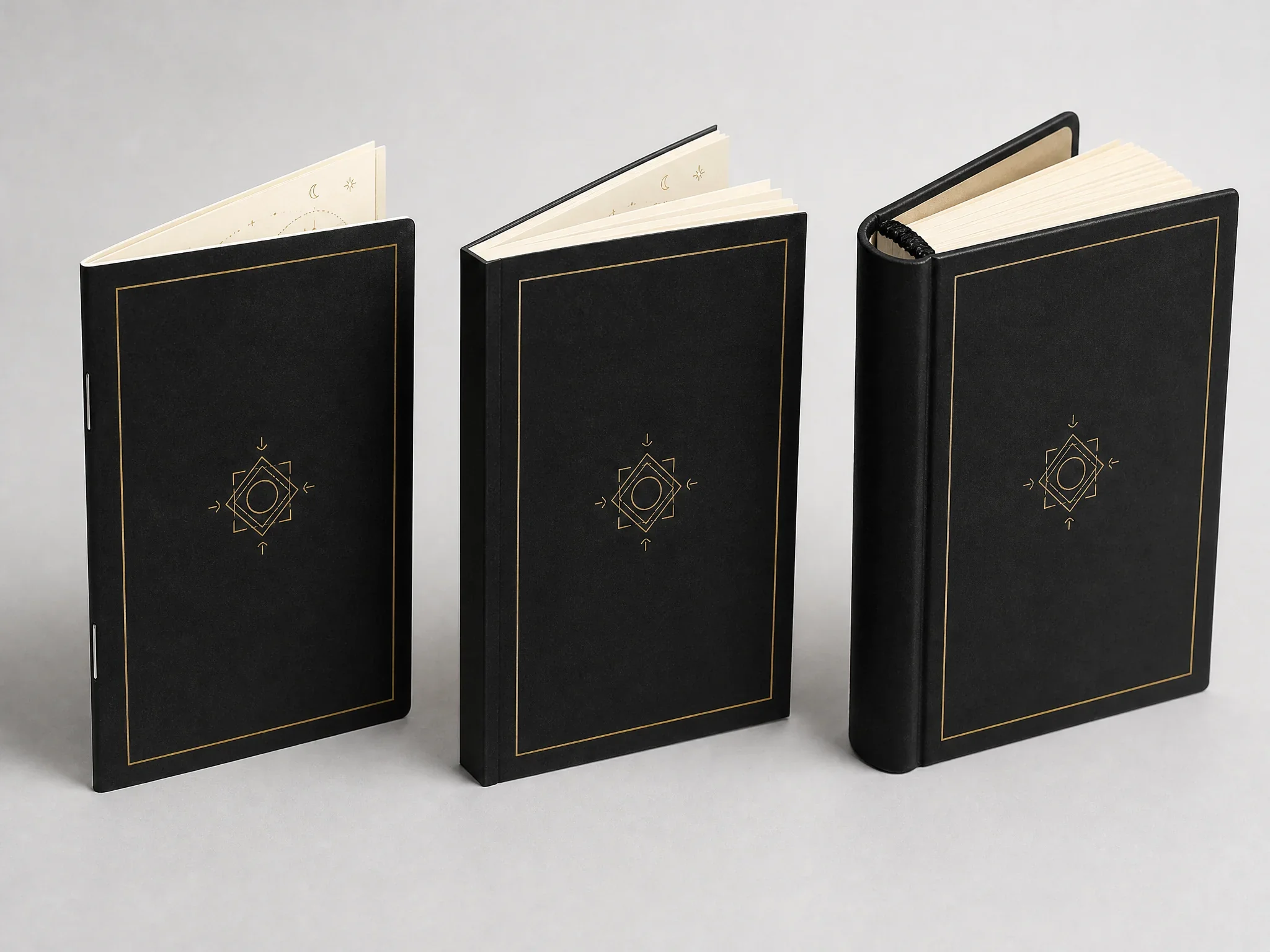
Left to right: saddle-stitched, perfect-bound with a printed spine, case-bound on rigid board.
Card Sizes and Deck Structure
The card size sets the box size, the cavity size and the print layout, so it is fixed before artwork is laid out. Standard tarot is 70 x 120 mm, which leaves room for a title band and a full image; oracle decks are usually wider at 88 x 125 mm; mini decks run to about 44 x 80 mm and are cut from a larger sheet with more cards up, which changes the price per deck. Deck count is your structure: 78 cards for a full tarot, 44 or 56 for an oracle, and any count in between if the deck is built that way.
| Specification | Standard | Options |
|---|---|---|
| Card size | 70 x 120 mm | 66 x 120 mm, 88 x 125 mm, 44 x 80 mm mini |
| Deck count | 78 cards | 44, 56 or your own structure |
| Card stock | 350 gsm coated art card | 300 gsm, 400 gsm, black core, linen, uncoated cream |
| Card edges | Plain cut edge | Gold gilded, other metallic tones, coloured edge |
| Corners | 3 mm radius | 2 mm to 5 mm radius, or square |
| Box | Magnetic flip rigid box | Lid and base, drawer, tin, folding box |
| Foil | One foil colour | Gold, rose gold, silver, copper, holographic |
| Guidebook | Perfect-bound, full colour | Saddle-stitched, case-bound, black plus one |
Where These Decks Are Used
These sets are bought by independent deck creators, publishers and studios who need a finished product, not a stack of cards. The pattern is a deck funded or pre-sold before it is printed, where the box and the guidebook are part of the promise, and a set that arrives as a plain tuck box undersells the deck inside it. Deluxe editions often add a cloth pouch beside the deck, and we produce a custom jewelry pouch with logo on the same artwork for that tier.
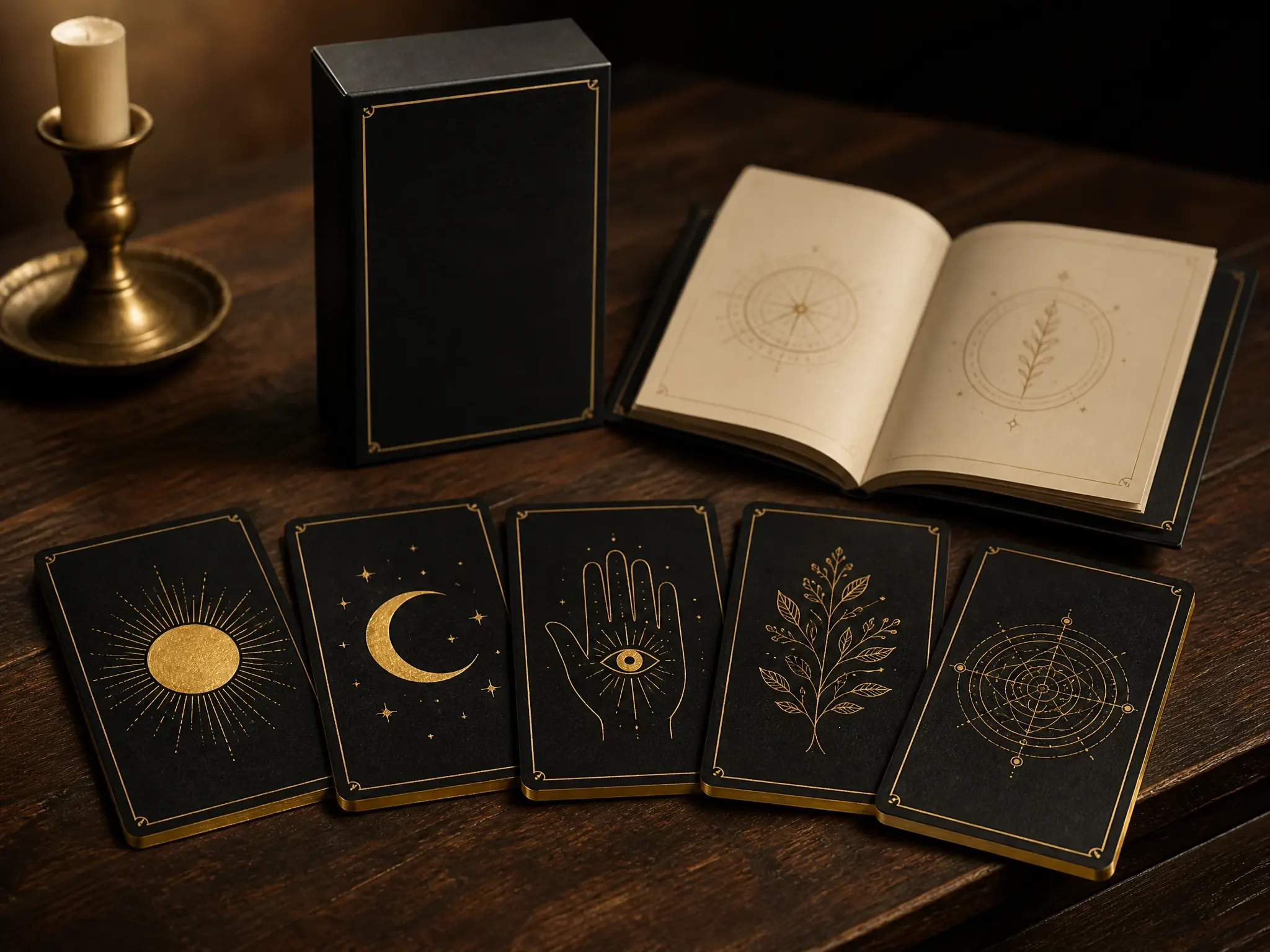
A deck, its box and its guide: the set is designed to be opened, not just shipped.
How the Run Is Controlled
A tarot set has more places to go wrong than a book, because four components have to match and one of them is 78 identical cut pieces. Longyin International Printing Group Limited prints in a 20,000 square metre plant in Shenzhen Longhua with more than 300 employees, including 50 technical specialists with ten or more years on press and in the bindery. Control on a deck run is built around four checks:
- Deck order and count. Every deck is counted and checked against the sequence before it is banded, so a missing or duplicated card does not reach a customer.
- Colour across components. The lid, the card back and the book cover are matched to one approved sheet, held to a Delta-E under 2.0, so the set does not show three blacks.
- Edge and cut quality. Cutting is held to plus or minus 0.5 mm, and the edge is inspected before gilding because a gilded deck shows any step in the block.
- Foil and closure. Foil is checked for fill and lifting, and every box is opened and closed so the magnets meet and the lid sits level before it is packed.
The plant runs Kodak CTP platemaking, Heidelberg and Komori four to eight colour presses, and Martini binding lines, so prepress, printing, cutting, foil, binding and box making are in the same building rather than split across suppliers. The group is certified to ISO 9001, ISO 14001, FSC chain of custody and BSCI social compliance, verified by SGS, and orders can run through Alibaba Trade Assurance.
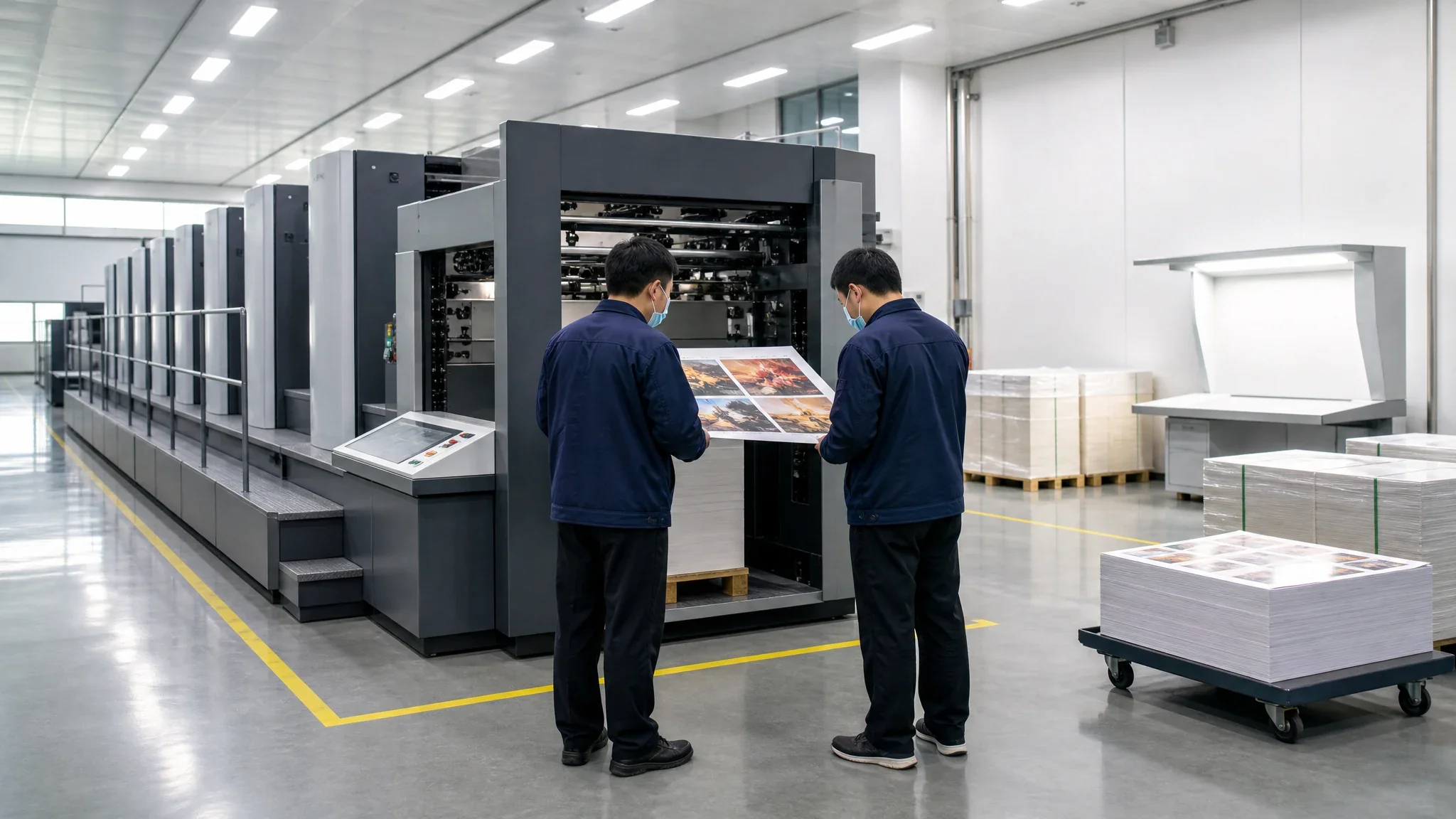
Sheet-fed presses, and printed sheets checked against the approved proof before cutting.
Proofing, Die Making and Colour Approval
Nothing is cut before the white dummy stands up and the colour is approved on a proof, because a deck is an expensive thing to discover a problem with after 78 cards are printed. The sequence is fixed: artwork is checked for bleed, foil areas and cut allowance; a die is made for the card size and the box; a white dummy is made up so the depth, the lid fit and the cavity are tested in the hand; the printed sheet is approved against your colour reference; and only then is the deck printed and the boxes wrapped. Foil and gilding are approved on a made-up sample rather than on a flat sheet, because both change appearance once the piece is formed.
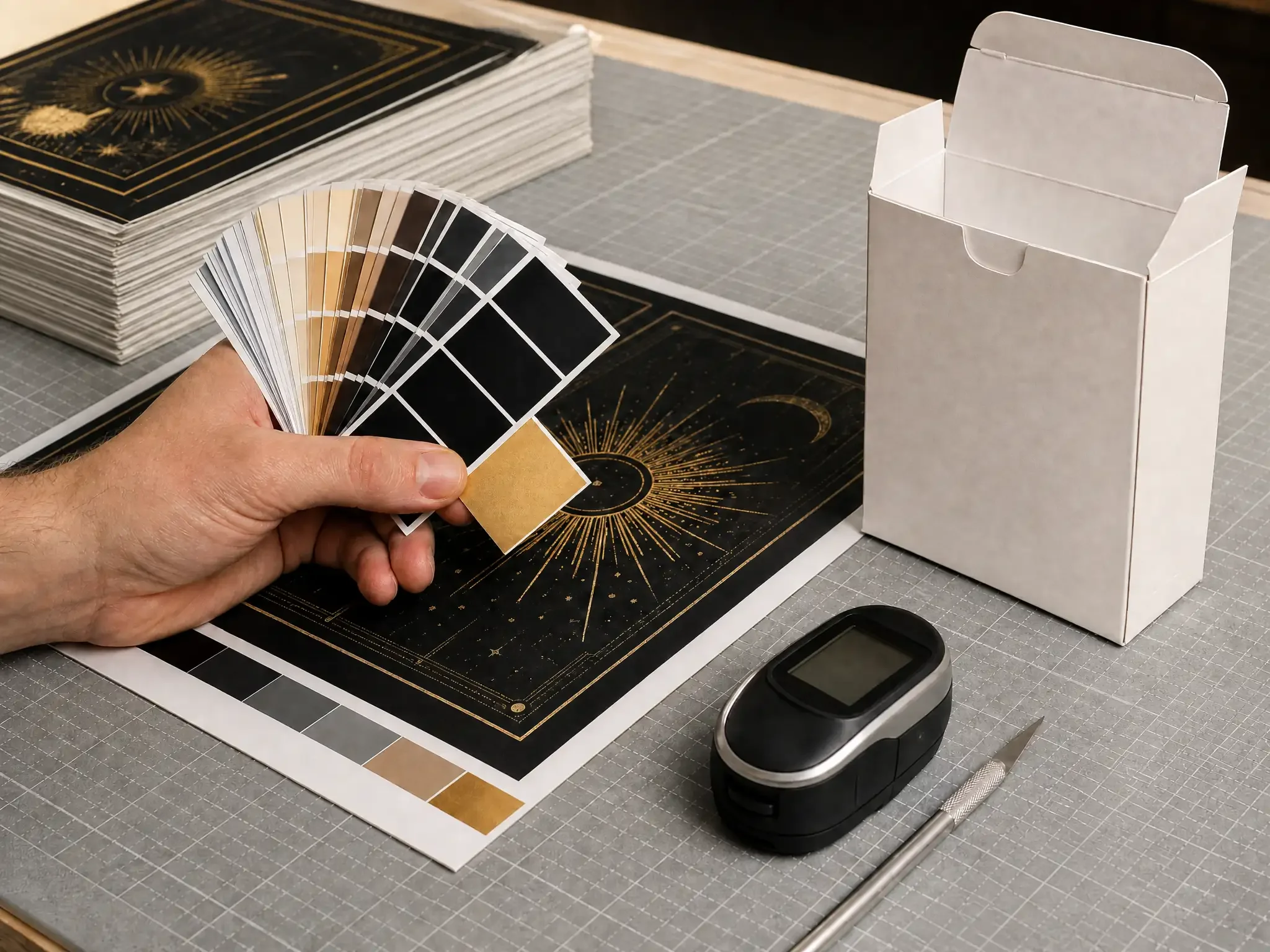
Colour fan, proof sheet and a white dummy built from the die, approved before the run starts.
Minimum Order, Sampling, Lead Time and Payment
The minimum order is 50 sets, and a trial run at that quantity is accepted before a larger run. Sampling takes 3 to 5 days once the artwork and the die are settled. Bulk production runs 7 to 15 days for quantities under 5,000 sets, and 5 to 10 days for runs of 50 to 100 sets, counted from artwork approval to dispatch. Air freight takes about 5 to 7 days and sea freight about a month. Payment is 40 percent deposit with the 60 percent balance before shipping, and confirmed quality issues are covered by a free reprint or refund. Quotes are issued within 24 hours of receiving your specification, with replies inside 2 hours.
Send the deck count and card size, the stock and finish, whether the edges are gilded, the box format and dimensions, the foil artwork, and the page count and binding for the guidebook. The box is a rigid format, and the wider packaging box printing range we run covers the other structures if a set needs a different outer.
Key Takeaways
- A custom tarot card set is the deck, a magnetic flip rigid box, gilded edges and a bound guidebook produced to one artwork, so the black and the foil match across all four.
- A magnet closure holds the same force after years of opening, where a tuck flap softens and stops gripping.
- Hot foil sits in a shallow impression in the sheet, which is why it reads as part of the box rather than as gold ink on top.
- Gilding is applied to the cut, collated block, so the three open sides carry one continuous gold face.
- 350 gsm coated art card is the default; black core, linen and uncoated stocks change the shuffle and the look.
- The minimum order is 50 sets, sampling takes 3 to 5 days, and bulk production is 7 to 15 days under 5,000 sets.
Frequently Asked Questions
What is included in a custom tarot card set?
The deck, the box with a magnetic flip lid, the ribbon lift under the deck, and the bound guidebook, all printed to one artwork. A pouch or a printed card can be added to the set.
What stock are tarot cards printed on?
350 gsm coated art card as standard, with 300 gsm, 400 gsm, black core, linen textured and uncoated cream available. The stock decides the shuffle, the weight in the hand and how the foil behaves.
Can the cards have gold foil and gold edges?
Yes. Foil is stamped on the card back and the box lid from the same artwork, and the deck can be gilded on the cut edges. Foil is kept clear of the corner radius because foil lifts at a cut corner.
What is a magnetic flip box?
A rigid board box with the lid hinged along the back and two magnets in the front walls. The lid stays attached and closes with a click, and the walls stay flat over a thick deck and a book.
Can the guidebook be printed and bound with the deck?
Yes. Saddle-stitched up to about 48 pages, perfect-bound for a square printed spine, or case-bound for a rigid cover. All three are printed on the same press as the cards and the box wrap.
What is the minimum order?
50 sets, and a trial run at that quantity is accepted. Larger runs reduce the cost per set because the die and the set-up are shared.
How long does sampling and production take?
Sampling is 3 to 5 days once artwork and the die are settled. Bulk production is 7 to 15 days under 5,000 sets, and 5 to 10 days for 50 to 100 sets. Air freight adds about 5 to 7 days.
Can you print an oracle deck instead of a 78 card tarot?
Yes. 44 and 56 card decks are produced on the same lines, with a wider card size if the artwork needs it, and the box and guidebook are built around the deck count.
Send your specs and get a custom quote.