Bulk Wall Calendar Printing: What to Send Before You Ask for a Quote
Bulk wall calendar printing quotes are only as accurate as the specification behind them. Seven items decide the figure: format and binding, open size, page count and start month, cover and inside stock, hanger and finishing details, quantity with the delivery date, and the status of the artwork. Send all seven in one enquiry and the price comes back as a firm number instead of a range that moves once the order is running. Working through that checklist before the quote request is exactly what the Shenzhen Longyin Printing Packing Co., Ltd. team does with buyers before a calendar run is priced.
Key Takeaways
- A quote is only as accurate as the spec: seven items decide the number, and a missing one turns a firm quote into a provisional range.
- Open size comes first: the buyer looks at the open size, and the printer buys paper against the sheet it cuts from, so two calendars that look alike on a wall can need different sheets.
- Binding sets the format: saddle stitched, wire-o or spiral, desk and 365-day lines sit in different production windows, from 5-7 days up to 18-20 days.
- Page count and start month are separate answers: a 12, 13 or 16-month grid changes the extent, and saddle stitched calendars must land on a multiple of four pages.
- The calendar printing lead time runs in three stages before freight: file check, sample, then production, and the calendar rows range from 5-7 days to 18-20 days, with runs above 5,000 copies adding 5-7 days.
Table of Contents
- What should you send a wall calendar printer to get an accurate quote?
- Which wall calendar formats and bindings change the quote?
- What wall calendar sizes should you specify?
- How many pages and which start month?
- Which paper and finishing choices matter?
- What is the production and shipping timeline for a bulk calendar order?
- How does sampling work before a bulk run?
- What payment and packing terms should be agreed?
- FAQ: Wall Calendar Printing Questions
Send your specs and get a custom quote.
What should you send a wall calendar printer to get an accurate quote?
Send seven items in one message: format and binding, open size, page count and start month, cover and inside stock, hanger and finishing details, quantity with the delivery date, and print-ready artwork. A printer quoting from all seven can price the sheet, the plates and the binding in a single pass, and the figure is firm rather than provisional.
The seven items, in the order they change the number:
- Format and binding – wall calendar, desk calendar or 365-day block, and how the pages are held together.
- Open size – the dimensions of the calendar when it is fully open, stated in millimetres or inches, plus the closed size if the format folds or divides into panels.
- Page count and start month – how many grids the calendar carries and which month opens the run.
- Cover and inside stock – the grammage and finish you want for the cover and for the inside pages.
- Hanger and finishing details – hanger bar or punched hole, drilling pattern, lamination, and how the finished calendars are packed.
- Quantity and delivery date – the run quantity together with the date the calendars have to reach you.
- Artwork status – whether a print-ready file exists or a file still has to be prepared.
One missing line is enough to turn an accurate quote into a range. A wall calendar printing quote that names the sheet, the plate count and the binding stage is a quote built on a complete specification, which is why the checklist is worth sending in one message rather than spread across three replies.
Which wall calendar formats and bindings change the quote?
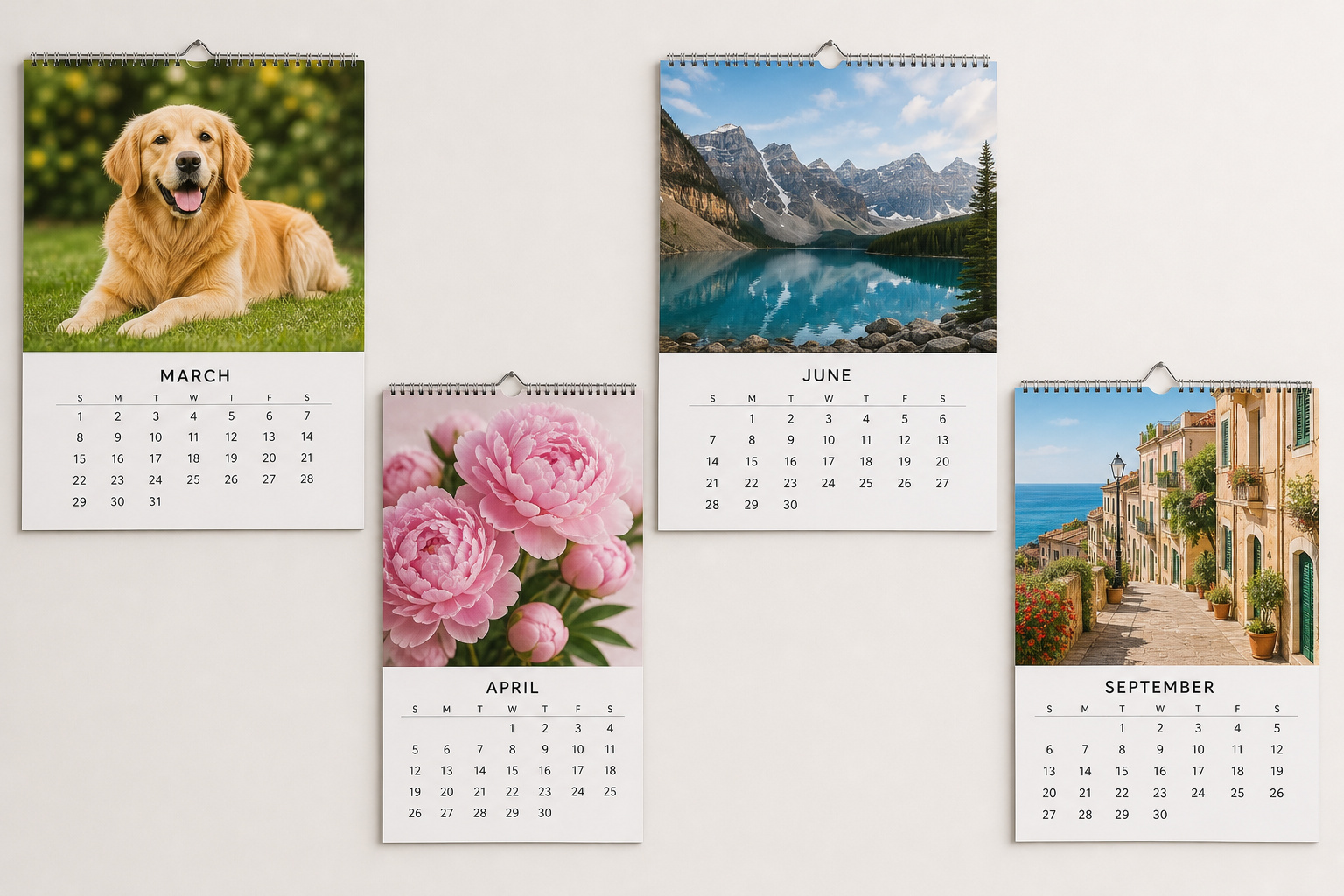
Format decides both the machine and the price. Saddle stitched calendars run as a folded sheet; wire-o and spiral calendars need punched pages and a hanger bar; desk calendars add a stand or a tent fold; 365-day calendars are built from thick stacked blocks. Each format sits in a different production window.
| Format | Best used for | How it is bound | Production |
|---|---|---|---|
| Saddle stitched wall calendar | Thin lines for wide distribution | Folded sheet, stitched through the spine | 5-7 days |
| Wire-o or spiral wall calendar | The standard hanging wall calendar | Punched pages on a wire or spiral, hanger bar at the top | 8-10 days |
| Desk calendar | Standing pieces for desks and counters | Tent stand or wire-o base | 10-12 days |
| 365-day calendar | One-page-per-day desktop blocks | Glued or wire-o block on a stand | 18-20 days |
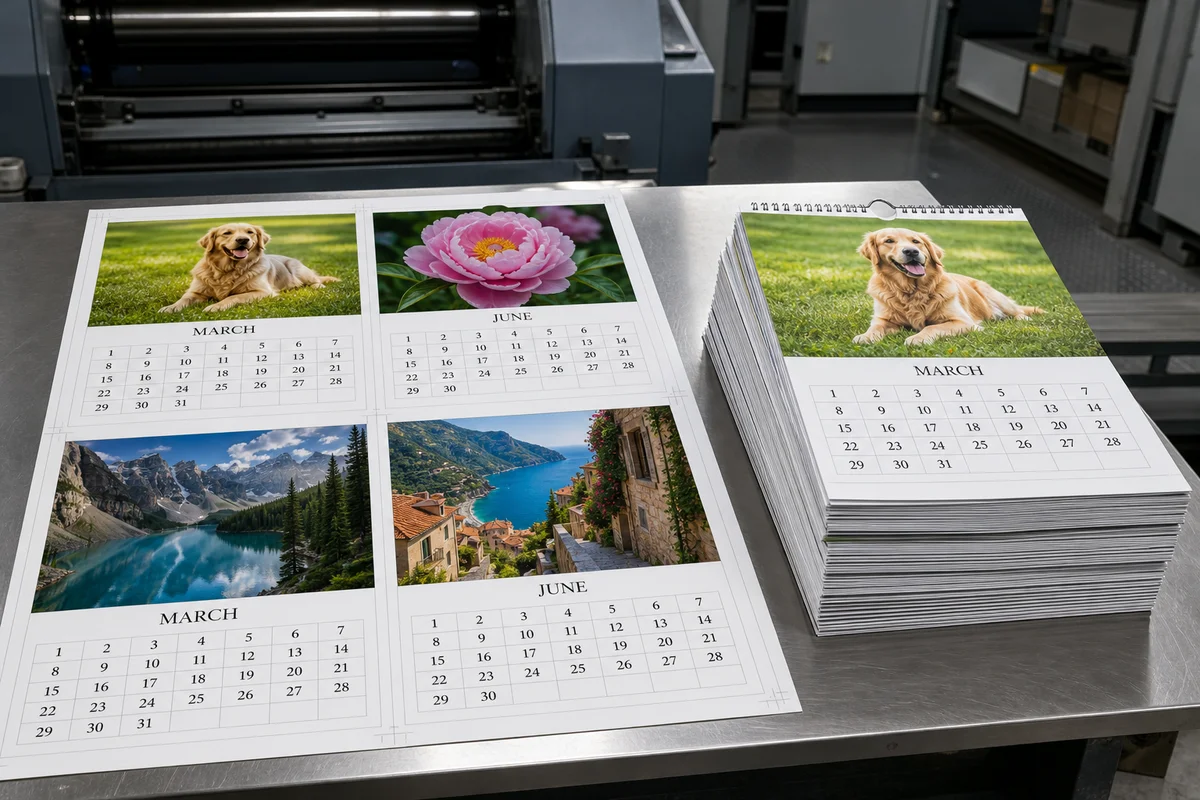
The binding stage is where a format stops being interchangeable. A hanging wire-o calendar needs every sheet punched to the same pattern and a hanger bar fitted at the head, and a 365-day block needs the whole stack glued or wired so single sheets tear away cleanly. Those are separate set-ups on separate machines, so a calendar that looks similar on a wall can carry a different price once the binding is named.
What wall calendar sizes should you specify?
Specify the open size first, then the closed size, because those are two different numbers on a hanging calendar. The open size tells the printer which parent sheet the calendar cuts from and how much of that sheet is used; a size that leaves awkward offcuts is billed whether or not it carries print.
Common hanging formats open to A3 or A2, and the closed size depends on how the artwork is split: a wall calendar that folds once shows half the open size when closed, while a calendar produced as single hanging leaves stays at the open size. Send both numbers and the unit you are working in, because a size written without units costs a reply to confirm and can change the sheet the printer selects.
This is also where wall calendar sizes affect the run rather than just the look. A size that fits the parent sheet cleanly leaves less trim waste, and less waste means the same paper order covers a longer run. A size that divides awkwardly does the opposite, so the size is worth re-checking against the sheet before the run is fixed.
How many pages and which start month?
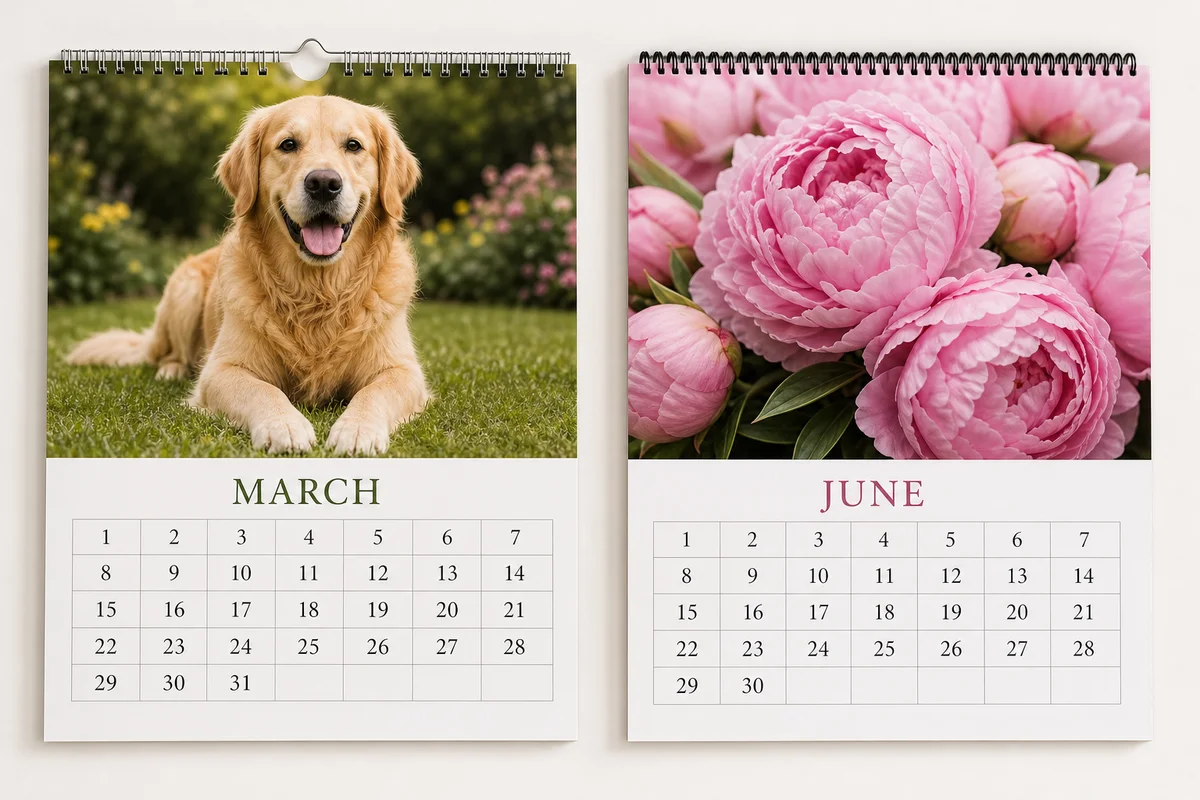
Page count and start month are two separate answers. A 12-month calendar, a 13-month calendar carrying one extra grid, and a 16-month calendar that opens in the previous autumn are different extents, and a saddle stitched calendar must land on a multiple of four pages, so a 13-page extent is usually built as 16 pages.
The start month decides which grid opens the calendar and where the run of months ends. Buyers planning a January start often want the final grid to carry a few weeks of the following period, which is why 13-month layouts exist; a layout that opens earlier in the year is chosen when the calendars have to be distributed before the calendar period begins. Say the start month explicitly rather than sending a file and expecting it to be inferred.
Extent also interacts with the binding. A saddle stitched calendar with an extent that does not divide by four has to be padded with blank pages or moved to a wire-o binding, and both outcomes change the sheet count. Naming the page count and the start month in the same message lets the printer flag that before the quote is written.
Which paper and finishing choices matter?
Cover stock carries the artwork and takes the lamination, so it decides how the calendar looks on a wall. Inside stock decides bulk, stiffness and how the pages hang. Add the hanger type, the drilling pattern, the lamination finish and the packing method, because each one is a separate stage that has to be set up on its own.
The choices that most often change a quote:
- Cover stock and finish – a heavier cover holds its shape on a wall, and a matte or gloss lamination changes both the look and the handling.
- Inside stock – thinner pages keep a hanging calendar light, while heavier pages feel firmer and increase the weight of the packed carton.
- Hanger – a metal hanger bar, a punched hole or a drilled head, chosen to match how the calendar will be displayed.
- Drilling and punching – the pattern has to match the binding, and it is decided before the pages are printed.
- 梱包 – whether calendars are shrink wrapped, stacked flat, or packed with a stiffener, because the carton has to protect the corners in freight.
Calendar formats, wire-o and spiral lines, desk units and 365-day blocks are all produced on the same calendar printing line, which is why the advice is to send stock and finishing choices with the size: a printer who sees the hanger, the lamination and the carton spec can price the finishing stages at the same time as the printing.
Custom wall calendar printing also means the artwork set is built for one order, so tell the printer how many artwork panels the run needs. A hanging calendar usually needs one panel per grid plus a cover panel, and a desk calendar needs its own layout for the stand, so the panel count is part of the specification rather than a detail for later.
What is the production and shipping timeline for a bulk calendar order?
The calendar printing lead time for a bulk order runs 5-7 days for saddle stitched calendars, 8-10 days for wire-o or spiral, 10-12 days for desk calendars and 18-20 days for 365-day blocks, counted from confirmed files to shipment. Runs above 5,000 copies add 5-7 days, then freight adds 5-7 days by air.
| Stage | Scope | Time |
|---|---|---|
| Pre-press file check | Print-ready file, no special process | 1-2 days |
| Sample | Confirmed file to finished sample | 1-2 days |
| Sample with special finishing | Foil, emboss, die cut or other special process | add 2-3 days |
| Production | Saddle stitched wall calendar | 5-7 days |
| Production | Wire-o or spiral wall calendar | 8-10 days |
| Production | Desk calendar | 10-12 days |
| Production | 365-day calendar | 18-20 days |
| Volume effect | Runs above 5,000 copies | add 5-7 days |
| Freight | Air | 5-7 days |
| Freight | Sea | within a month to nearby regions, 2-3 months to remote |
Read together, the calendar printing lead time is a sum of stages rather than one figure: the file check and the sample come first, the production window follows the format, and the freight window depends on the route. A stage-by-stage view of the same timeline, including what each day belongs to, sits in our how long does book printing take article.
Two of those stages are worth fixing in the enquiry itself. If the calendars have to be delivered by a specific date, say so when the quote is requested, because production can be scheduled around a delivery window rather than booked as soon as the file is ready. If the run is likely to grow, say that too, since the volume step above 5,000 copies changes the schedule by the same 5-7 days regardless of format.
How does sampling work before a bulk run?
Sampling runs in six steps: contract signed, sampling fee paid, files supplied, files confirmed, sample made, sample shipped. On a standard process with a print-ready file, checking takes 1-2 days and the sample is made in 1-2 days after files are confirmed; special finishing adds 2-3 days.
A sample is the point where the specification stops being a description. The hanger, the drilling pattern, the lamination finish and the way the grids sit on the page are all checked on a physical copy before the run is released, and corrections made at that stage cost far less than corrections made after printing.
The sampling fee follows a stated policy rather than a general rule. Where a tooling or special-process plate fee applies and the production run keeps the same artwork, that portion is refunded once the order reaches 1,000 copies or more. Where no tooling or special-process plate fee applies, the sampling fee is not refunded. Agreeing that in advance keeps the sample stage predictable, and custom wall calendar printing runs of this kind are scheduled against the sample approval date rather than the enquiry date.
What payment and packing terms should be agreed?
Payment runs on a 40% deposit with the balance settled before shipment. Packing is agreed at the same time: how many units per carton, whether cartons are labelled by destination, and whether the order ships to one address or several. Agree both before production starts, because packing changes the carton count and the freight quote.
Packing matters more for calendars than for many printed products. Hanging calendars are easily creased at the corners, and a carton that is packed without a stiffener protects the printed face but not the head where the hanger is fitted. State the carton count you can handle at the receiving end, and whether the order has to be split across several delivery addresses; both answers feed straight back into the freight figure.
Terms are also where a quote shows how it was built. A figure that stands up to a written specification, with the sheet, the binding stage and the finishing named, tells you what you are buying; the patterns to look for are set out in our why book printing quotes differ article, which covers what a lower or higher number usually reflects.
After delivery, quality problems are handled directly: where the calendars are unusable, the run is reprinted or refunded. That commitment is worth confirming in writing at the same time as the deposit, so the terms are agreed before production rather than after the cartons arrive.
FAQ: Wall Calendar Printing Questions
These are the six questions buyers ask most often before a bulk calendar order is placed, answered directly so a spec can be checked against the list a printer will ask for. Each answer states the deciding rule first and the practical effect second.
Q1: What do I need to send for a wall calendar printing quote?
Send seven items: format and binding, open size, page count and start month, cover and inside stock, hanger and finishing details, quantity with delivery date, and artwork status. A quote built on all seven comes back as a firm figure.
Q2: What wall calendar sizes are standard?
Hanging calendars commonly open to A3 or A2, and the closed size follows how the artwork is split across panels. Send both the open and closed dimensions with units, because the open size decides which parent sheet the printer cuts from.
Q3: Should I choose wire-o, spiral or saddle stitched binding?
Choose the binding from the format and the page count. Saddle stitch suits thin folded calendars and runs 5-7 days; wire-o and spiral suit standard hanging lines and run 8-10 days; desk calendars run 10-12 days and 365-day blocks 18-20 days.
Q4: How long does bulk wall calendar printing take?
Production runs 5-7 days for saddle stitched calendars, 8-10 days for wire-o or spiral, 10-12 days for desk calendars and 18-20 days for 365-day blocks, counted from confirmed files to shipment. Above 5,000 copies add 5-7 days.
Q5: Can every calendar in one run have its own cover?
No. One artwork set is used per order and every copy in the run is printed identically, so the cover stays the same across the whole quantity. Giving each copy a different cover would need a separate plate or die for every unit.
Q6: What happens if the calendars arrive damaged?
Two cases are handled differently. Where the shipment is damaged or lost in transit, the carrier settles the value of the goods and the freight, and any reprint is agreed with you. Where the finished calendars are unusable because of a quality problem, the order is reprinted or refunded.
Written by the Longyin Printing team – book and calendar printing specialists for publishers, brands and distributors worldwide.
Send your specs and get a custom quote.